A CLOSER LOOK
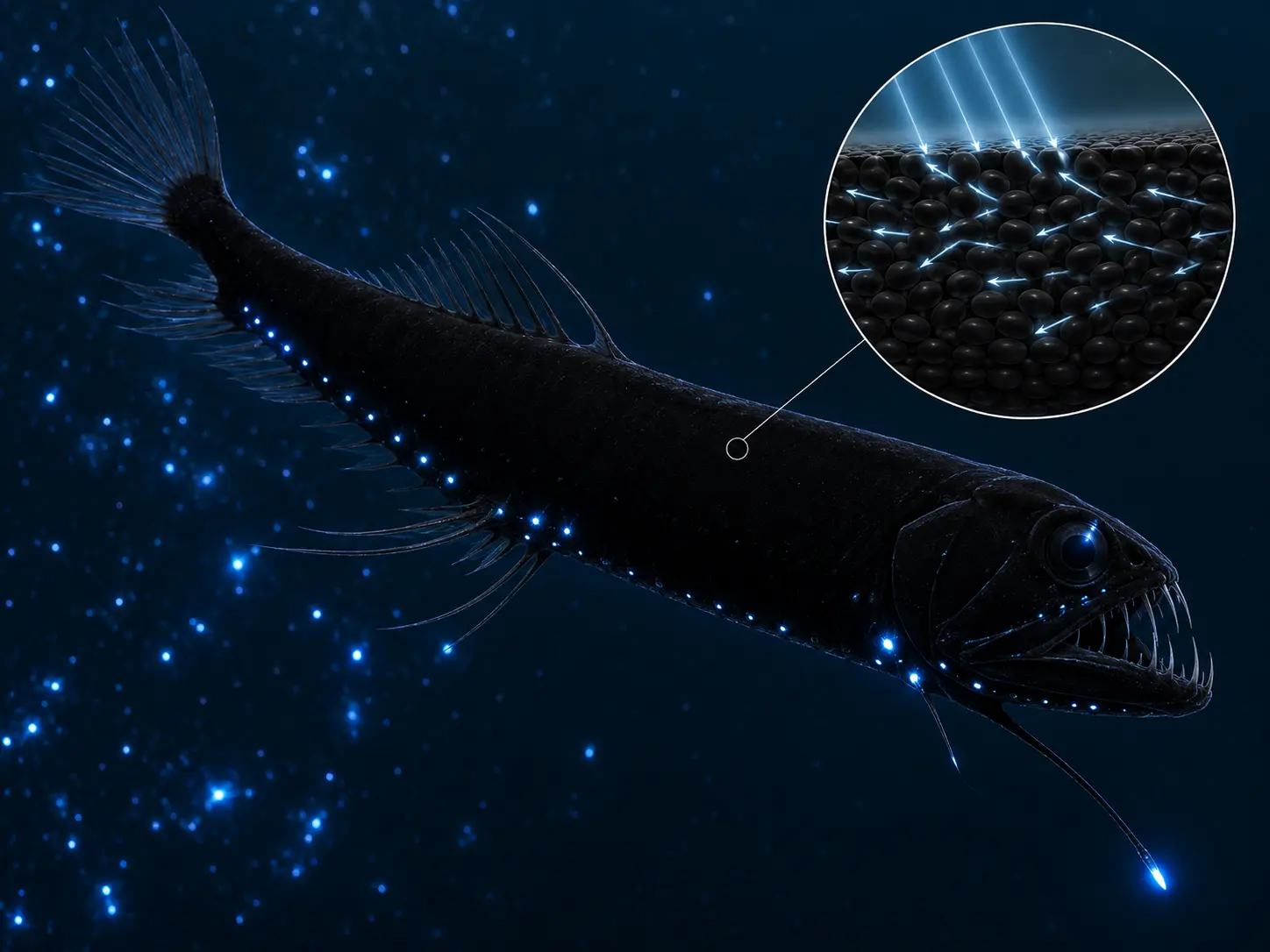
Below roughly 200 metres, sunlight dwindles while flashes and beams from living organisms remain important sources of light. A predator’s bioluminescent searchlight can expose an animal against dark water. Mirrored or transparent camouflage may reflect a directed flash, making very low-reflectance skin useful in the open midwater where there is no seafloor or vegetation nearby for cover.
A 2020 study measured specimens from 18 deep-sea fish species and identified ultra-black skin in 16 species spread across seven distantly related orders. The result points to repeated evolution of a similar optical solution. The group included predators and potential prey, so the camouflage may help an animal approach food, avoid detection, or do both depending on its ecology.
The darkest measured skin reflected as little as 0.05 percent of incident light. Researchers defined the studied ultra-black condition as reflectance below 0.5 percent. Optical modeling estimated that this could reduce the distance at which a visual predator detects a fish by more than sixfold compared with skin reflecting 2 percent of the same light.
Melanin is packaged inside microscopic structures called melanosomes. In ordinary dark fish, pigment cells can leave unpigmented gaps that return some light. Ultra-black species studied by the team had a continuous layer of densely packed melanosomes near the skin surface. Their size, shape, and arrangement scatter incoming light sideways within the layer, lengthening its path through melanin and increasing the chance that it will be absorbed.
The arrangement achieves strong absorption with a comparatively simple biological structure. It differs from some engineered ultra-black materials that rely on elaborate forests of tiny tubes or other complex surfaces. The researchers suggest that the fish may inspire durable optical coatings, while the study demonstrates a natural mechanism rather than a ready-made manufacturing process.
Ultra-black is a measurement, not an assertion that a fish is invisible under every condition. Eyes, teeth, damaged skin, body edges, and emitted light can still supply visual cues. Measurements came from collected specimens and models of particular viewing conditions. They support a large reduction in reflected light without establishing exactly what every predator or prey species perceives in the wild.