A CLOSER LOOK
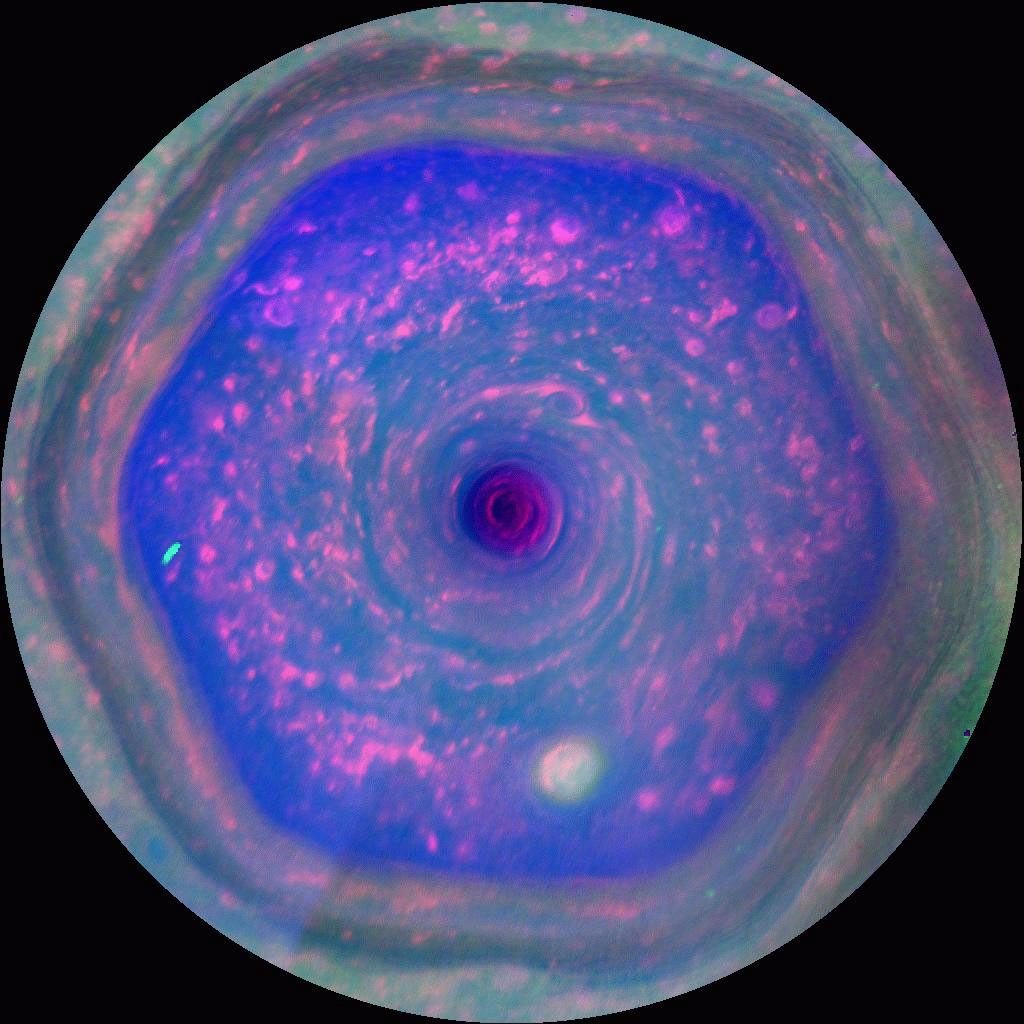
NASA describes the hexagon as a wavy eastward jet stream near 77 degrees north latitude. It spans about 30,000 kilometres and carries winds near 200 miles per hour. The sharp-looking corners do not form walls, and the feature is not a single solid storm. Gas follows a circulating atmospheric pattern on a planet with no solid surface below the clouds.
A hurricane-like vortex turns around the north pole inside the hexagon. Smaller vortices and cloud systems circulate between that central storm and the six-sided boundary. Cassini movies were mapped in a frame rotating with Saturn, so motion in them shows weather moving relative to the planet rather than the ordinary spin of the whole globe.
Voyager images revealed the pattern in 1980 and 1981. When Cassini arrived in 2004, northern winter hid the pole from visible-light cameras, although infrared observations could still trace the hexagon. Sunlight returned across the full region in 2009. Later polar orbits let Cassini assemble high-resolution mosaics and movies from directly overhead.
The color-enhanced image combines ultraviolet, visible, and infrared filters to separate haze and cloud properties. NASA reported fewer large haze particles inside the hexagon than outside it, consistent with the jet acting as a boundary. Natural-color comparisons from 2013 and 2017 also show the polar region shifting from blue toward gold as seasonal sunlight increased and photochemical haze developed.
Long-term measurements find an exceptionally steady wave. Research combining Voyager, Cassini, Hubble, and ground-based images tracked the vertices and found that the hexagon and its jet survived major seasonal changes. The measured rotation period during 2008–2014 was about 10 hours, 39 minutes, and 23 seconds. Small changes between observing eras may reflect nearby vortices rather than a rigidly fixed polygon.
Researchers interpret the shape as a Rossby-type wave trapped along the polar jet, while studies of temperature and haze show that its influence extends above the visible cloud deck. That interpretation explains the geometry as fluid dynamics, though it does not settle every question about how deeply the jet is rooted or why Saturn’s southern pole lacks a matching long-lived hexagon.