A CLOSER LOOK
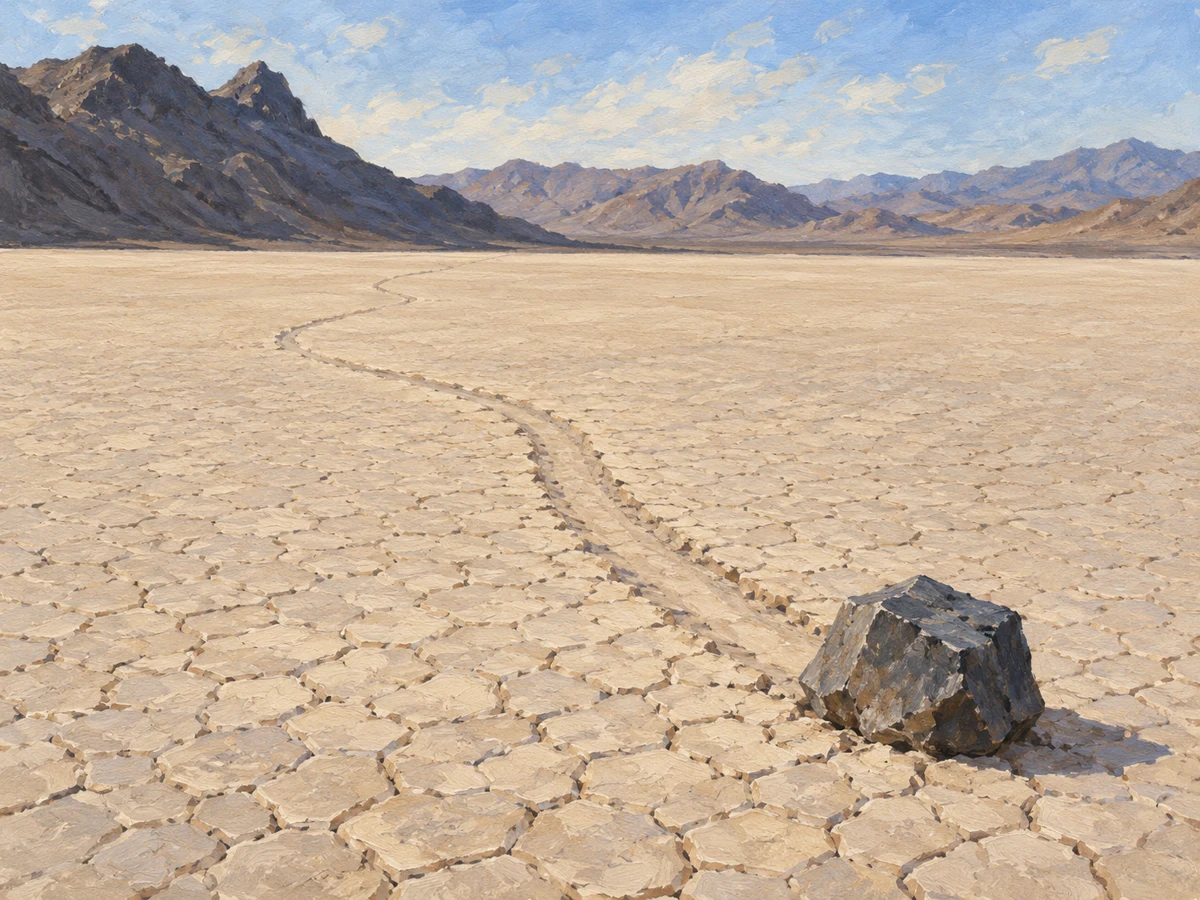
Racetrack Playa is a dry lakebed about three miles long and two miles wide in a remote part of Death Valley National Park. Rocks fall from the surrounding slopes onto an exceptionally flat bed of fine sediment. Some weigh hundreds of kilograms and leave paths extending hundreds of metres, yet an individual stone may remain motionless for a decade or longer.
Researchers placed a weather station, time-lapse cameras, and fifteen GPS-instrumented rocks at the playa in 2011. On December 20, 2013, they arrived while a shallow winter pond covered part of the surface and directly observed natural rocks moving. The combination of measurements and photographs produced the first scientific observation of the process in action.
Cold nights froze the pond into transparent “windowpane” ice only a few millimetres thick. Late-morning sunlight began melting and breaking the sheet into floating panels. Light winds drove those panels across the water. Ice accumulating against the exposed side of a stone supplied enough force to slide it over the soft mud below; the rocks were pushed rather than carried while frozen inside thick ice.
Measured winds were roughly four to five metres per second. Stones usually traveled about two to six metres per minute, slow enough to be hard to judge when nearby rocks and ice were moving too. Some motions lasted only seconds, while the longest GPS-recorded event lasted sixteen minutes. One large event moved more than sixty rocks, and distant stones could begin traveling together beneath the same broad ice sheet.
The observations explain synchronized tracks and show why the phenomenon is rare: the playa needs enough water to form a pond, a cold night to freeze it, ice thin enough to break and move, sunlight to open water around the panels, and wind strong enough to push them. The study did not directly observe the largest boulders moving, so the measured mechanism should not be stretched into a claim that every historical trail formed in an identical way.
The tracks are part of the scientific record. Driving onto the playa, walking across wet mud, or moving a rock can leave damage lasting for years and sever the relationship between a stone and its path. National Park Service guidance requires visitors to stay on established roads, avoid muddy areas, and leave the rocks where they are. The evidence survives only while the surface remains undisturbed.