A CLOSER LOOK
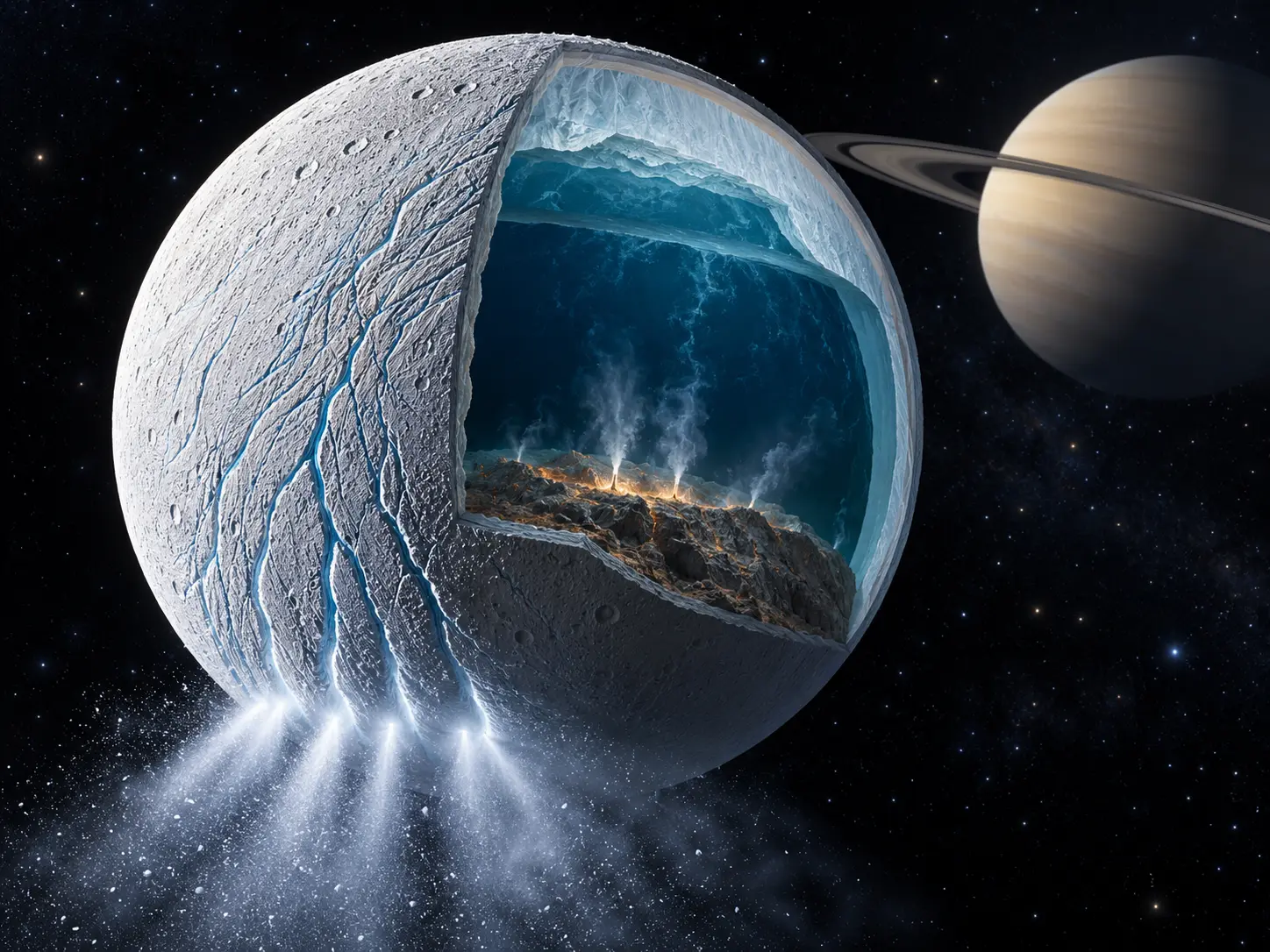
Cassini found jets of water vapor and ice escaping from long fractures near the south pole of Enceladus. Gravity measurements first supported a regional sea beneath the ice. Later observations of the moon’s slight orbital wobble showed that the icy shell moves independently from the rocky interior, evidence for a global liquid ocean between them.
Enceladus is about 500 kilometers across and circles Saturn once every 32.9 hours. It keeps the same face toward the planet. A gravitational resonance with the moon Dione maintains a slightly eccentric orbit, so Saturn’s pull repeatedly flexes Enceladus. The resulting tidal heating supplies energy inside a world that receives little warmth from the Sun.
The south-polar plumes feed Saturn’s broad E ring. Cassini flew through the spray and examined ocean-derived particles already carried into space. Salt-rich grains support contact between liquid water and rock. Tiny silica particles indicate hot water interacting with the rocky seafloor at temperatures around 90 degrees Celsius or higher, consistent with ongoing hydrothermal activity.
Scientists later reanalyzed Cassini dust measurements and detected phosphates in salt-rich ice grains. Laboratory experiments and models indicate phosphorus concentrations in the plume-forming ocean water at least 100 times those of Earth’s oceans. Phosphorus is essential to life as known on Earth, yet its presence is evidence about chemistry and possible habitability; it is not a detection of organisms.
Cassini also measured molecular hydrogen and organic compounds in plume material. Together with liquid water and water-rock reactions, those findings show several ingredients and energy sources relevant to habitability. Important uncertainties remain, including the ocean’s detailed circulation, the persistence of chemical gradients, and whether any environment there has ever supported biology.
The photographs of jets are direct observations of material leaving the moon. Claims about the ocean’s size, seafloor reactions, and composition come from several kinds of evidence: gravity and wobble measurements, particle analysis, gas measurements, laboratory comparisons, and physical models. Keeping those steps visible makes Enceladus more interesting without turning possibility into proof.