A CLOSER LOOK
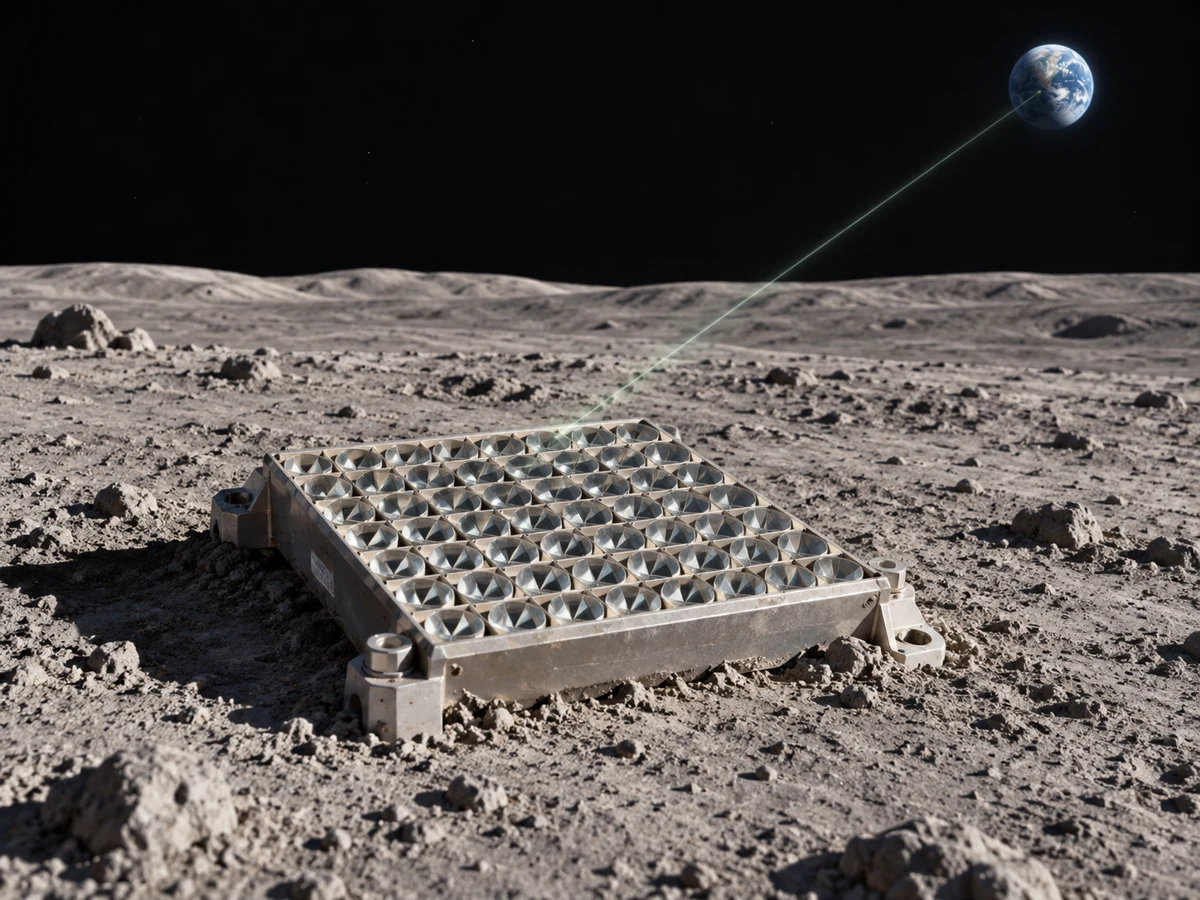
Apollo 11 astronauts deployed the first lunar laser ranging reflector in July 1969. Apollo 14 and Apollo 15 crews placed additional arrays, and Soviet Lunokhod rovers carried reflectors to two other sites. NASA continues to describe lunar laser ranging as an operational source of scientific data decades after those instruments reached the surface.
Each optical element is a corner cube: three mutually perpendicular reflecting faces return incoming light toward its source over a useful range of angles. An observatory sends short laser pulses toward a known array and records the few photons that make the round trip. The elapsed travel time becomes a distance after corrections for the atmosphere, the observing station, and the motion of Earth and Moon.
The Apache Point operation uses a 3.5-meter telescope in New Mexico. Its reference points are the telescope’s mount axes and a suitcase-sized reflector array on the lunar surface. Repeated measurements contribute to studies of the Moon’s orbit and interior, Earth’s rotation, and tests of gravitational physics. A single laser shot is not a simple ruler reading; useful results come from calibrated observations and long data series.
The returned signal is exceptionally faint. A laser pulse spreads on its way to the Moon, only part of it reaches an array, and the reflected beam spreads again before arriving at Earth. Dust, thermal effects, weather, and the Moon’s orientation can influence observations. The reflectors provide stable passive targets, while precision depends on observatory equipment, calibration, modeling, and many repeated measurements.