A CLOSER LOOK
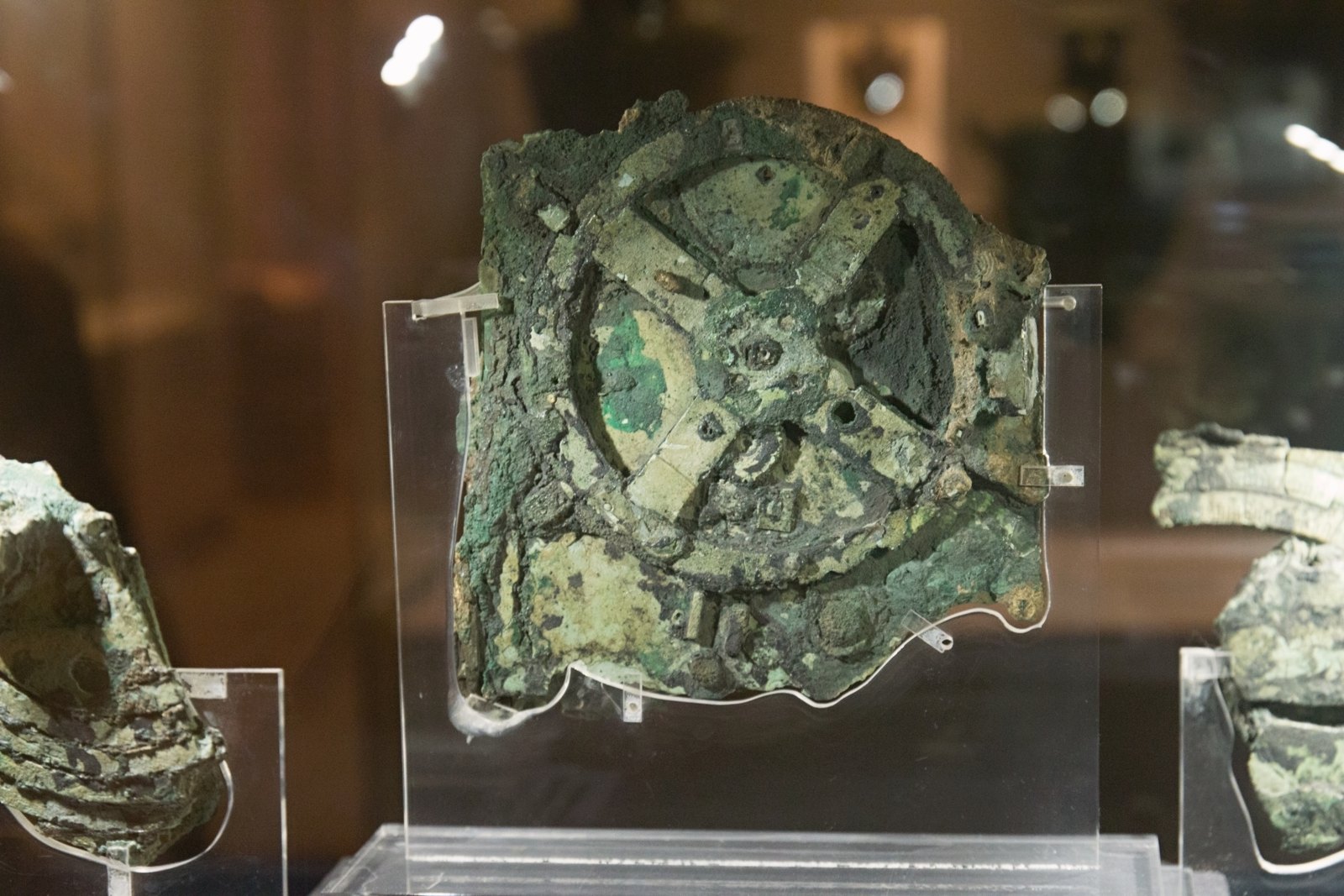
Sponge divers found the Antikythera shipwreck in 1900, and Greek authorities recovered its cargo in 1900–1901. A corroded lump split open after reaching Athens, exposing toothed bronze wheels. The National Archaeological Museum dates the mechanism to about 150–100 BCE. It had been housed in a wooden case, with display plates and inscriptions explaining what its pointers showed.
A user turned an input to move the displays through time. On the back, a spiral dial followed the 235 lunar months of the 19-year Metonic cycle, keeping a lunar calendar aligned with the solar year. Another spiral followed the 223-month Saros cycle. Its engraved cells identified predicted solar or lunar eclipses and included timing information; a smaller Exeligmos dial supplied an eight- or sixteen-hour correction across repeated Saros cycles.
A separate dial recorded the repeating schedule of major Greek athletic festivals, including the Olympic Games. That feature placed celestial calculation beside a social calendar. The device was not simply a clock and did not watch the sky by itself. It was a hand-operated model that translated established astronomical cycles into coordinated mechanical displays.
The Moon display captured more than an average orbit. A pin-and-slot arrangement varied the lunar pointer’s speed, approximating the Moon’s observed acceleration and slowing during its orbit, while another indication showed its changing phase. The surviving gearing joins mathematical astronomy with metalworking: relationships written as numerical periods became tooth counts, rotations, and pointers.
Researchers read the machine with X-ray computed tomography, reflectance imaging, and close study of the fragment surfaces. These methods reveal gears and inscriptions hidden beneath corrosion. Text on the covers describes the Sun, Moon, and the five planets known in antiquity, providing constraints for reconstructions even where the associated mechanism has disappeared.
Only about a third of the original device survives in dozens of fragments. The rear calendar and eclipse functions are supported by surviving gears and inscriptions, while the mostly lost front display requires more inference. Modern models can show that a proposed gear train fits the evidence and works mechanically; they cannot turn a plausible reconstruction into a recovered ancient part or settle every detail of the original design.