A CLOSER LOOK
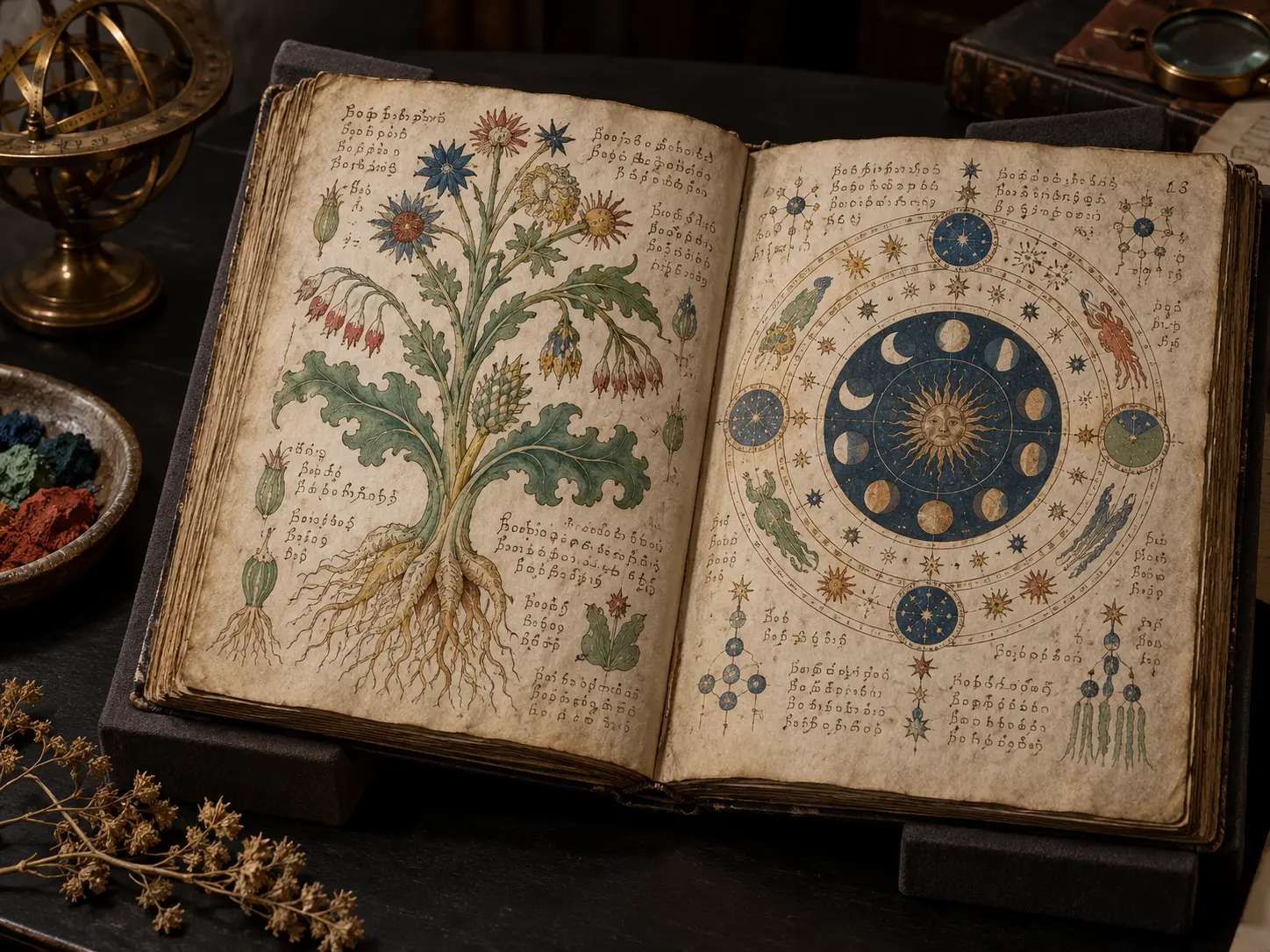
Yale catalogs the volume as Beinecke MS 408. Its unidentified script accompanies six broad groups of imagery: plants, astronomical and astrological diagrams, bathing scenes, cosmological medallions, pharmaceutical drawings, and pages of unillustrated text marked with star-like flowers. Those divisions provide clues about organization without supplying a reliable translation.
The first confirmed owner was Holy Roman Emperor Rudolph II, who bought the manuscript for 600 gold ducats. It later passed through the libraries of Jacobus Horčicky de Tepenec, Georgius Barschius, Johannes Marcus Marci, and Athanasius Kircher. Wilfrid Voynich purchased it from the Jesuit College at Frascati in 1912; bookseller H. P. Kraus donated it to Yale in 1969.
Material testing is more dependable than the many proposed decipherments. Yale reports that scientific analysis is consistent with a fifteenth-century manuscript, and its catalog documents missing leaves as well as the physical structure of the surviving volume. A linked chemical report examines the inks and pigments. These tests can narrow when and how the object was made without identifying its language or author.
High-resolution scans make the entire manuscript available for study while protecting the fragile original. Compare a botanical page with a circular diagram, then notice repeated signs and the changing relationship between text and pictures. Yale linguist Claire Bowern notes that word patterns can be studied even when meanings remain unknown; paleographic work indicates that five people collaborated in writing the book.
The manuscript has attracted confident solutions for more than a century. Yale does not systematically evaluate or endorse individual theories, and familiar-looking plants or symbols are not enough to prove a reading. A persuasive decipherment would need to explain the text consistently across the volume, survive independent scrutiny, and fit the physical evidence.