A CLOSER LOOK
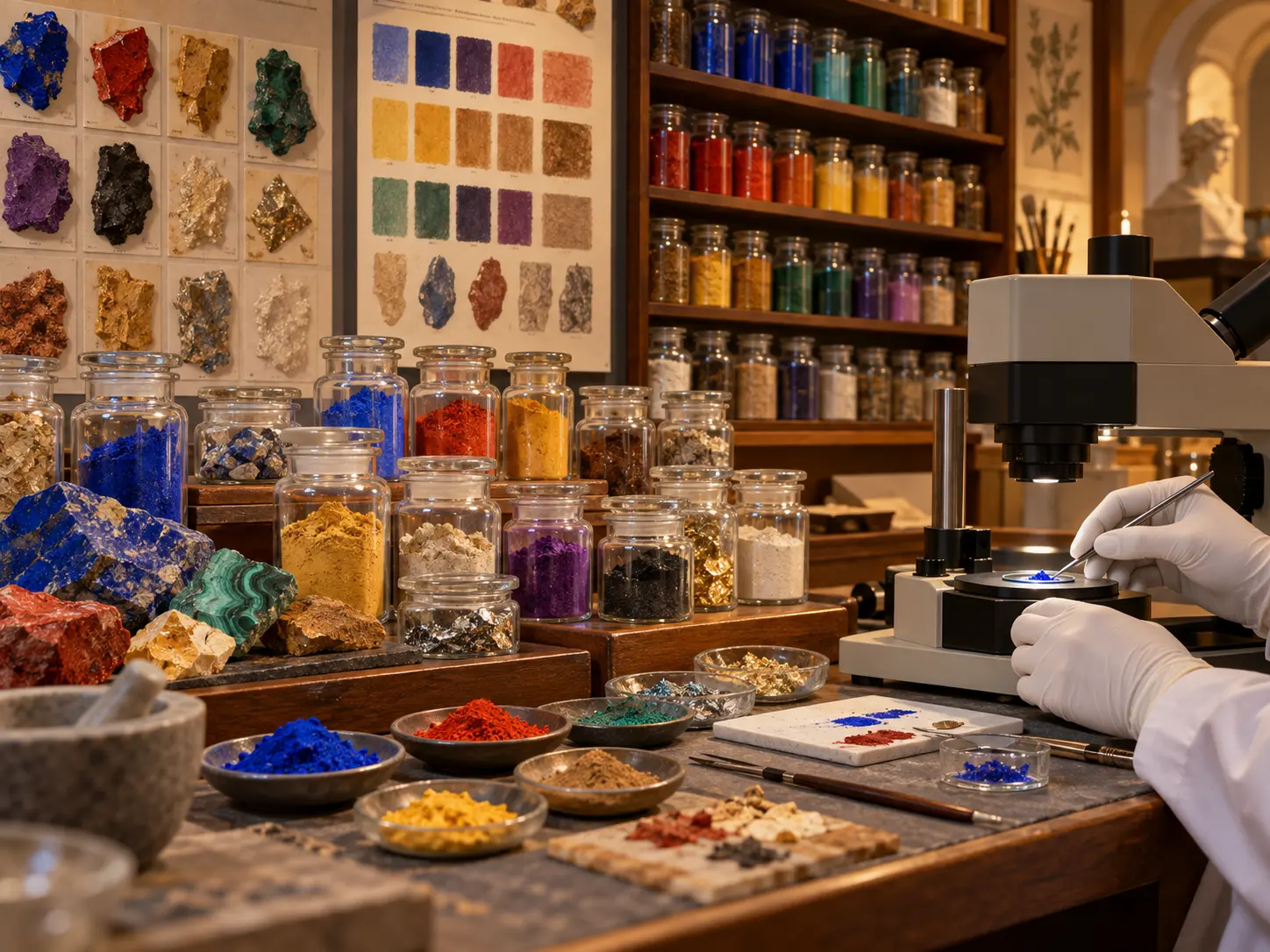
Edward Waldo Forbes, director of Harvard’s Fogg Art Museum from 1909 to 1944, began assembling pigments around 1910. He treated the museum as a laboratory for studying the materials inside artworks. Travel, purchases, and later donations built a collection that Harvard reported had grown beyond 2,500 samples and continued to expand.
A labeled vial becomes useful when its optical, chemical, and physical properties are compared with an unknown sample from an artwork or document. The Library of Congress uses a Forbes subset to study questioned or unstable media. Identification can help specialists investigate provenance and manufacture, recognize acidic pigments that threaten paper, and estimate whether a material is likely to remain stable.
The collection is distributed as well as displayed. Harvard holds the bulk, while the Library of Congress reports that nineteen other laboratories share subsets. Researchers can characterize particles with tools such as scanning electron microscopy and X-ray fluorescence, then add those measurements to reference data used by preservation specialists.
Matching a pigment does not by itself settle authorship or date. Artists mixed pigments with binders, layered colors, and changed recipes, while later restoration can introduce newer material. Harvard’s work on Mark Rothko’s murals showed why context matters: Lithol red powder was stable in testing, yet became highly light-sensitive when combined with ultramarine blue and a binding medium. The jars supply evidence; interpretation still depends on the artwork, its history, and several forms of analysis.