A CLOSER LOOK
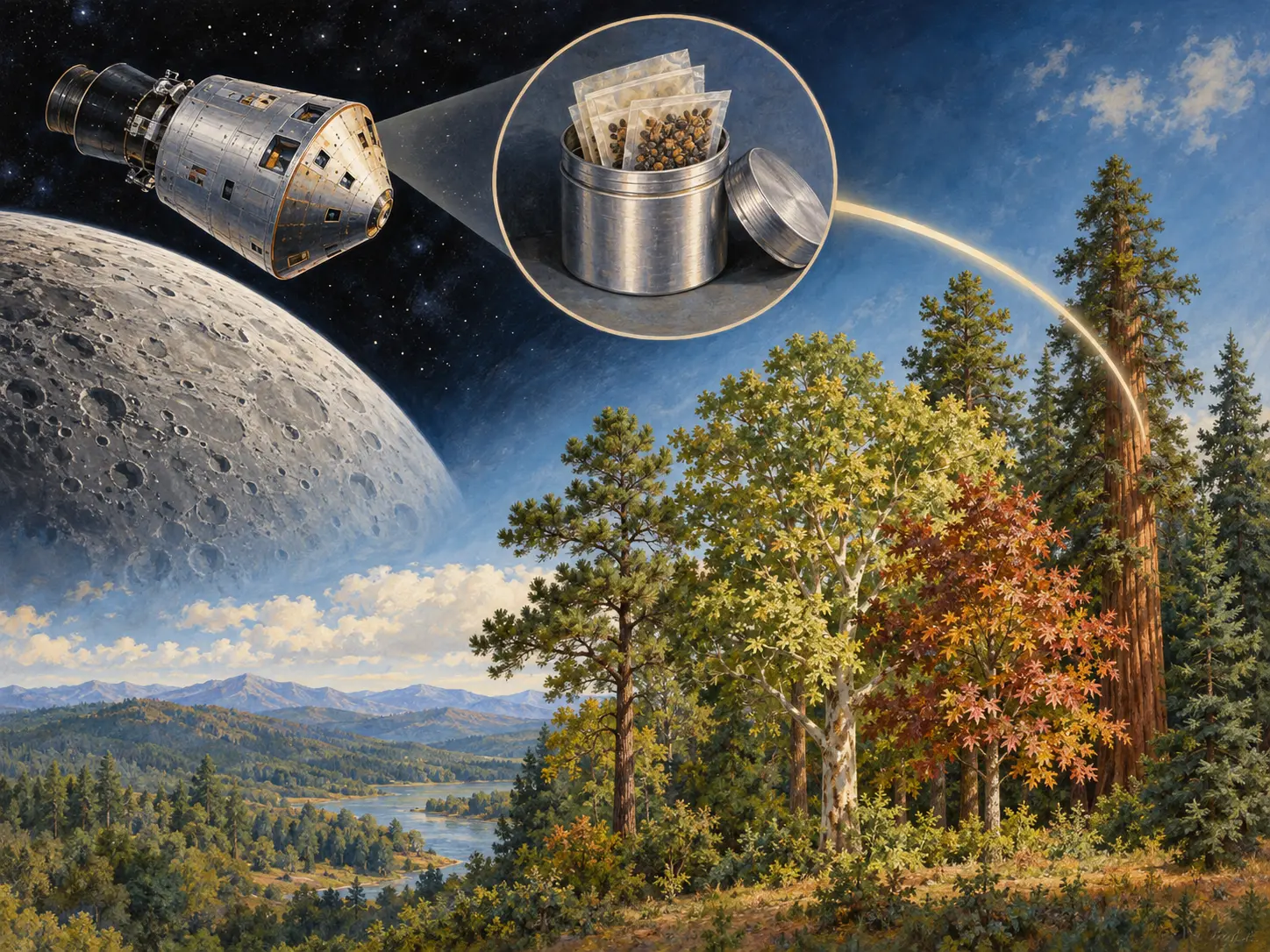
Apollo 14 launched on January 31, 1971. While Alan Shepard and Edgar Mitchell descended to the lunar surface, command module pilot Stuart Roosa remained in lunar orbit aboard Kitty Hawk. In his personal kit was a metal canister holding hundreds of seeds for a joint NASA and U.S. Forest Service project. The seeds stayed inside the spacecraft; they were never planted on the Moon.
Forest Service scientist Stan Krugman selected seeds from five kinds of tree: loblolly pine, sycamore, sweetgum, redwood, and Douglas fir. Matching control seeds remained on Earth. During postflight decontamination, the space-flown bags burst open and the seeds were scattered and exposed to vacuum. Their viability looked doubtful, yet later germination efforts at Forest Service stations produced many seedlings.
Some seedlings were paired with their Earth-bound counterparts. NASA reports no discernible difference between them after decades of growth. The flight therefore did not create a new tree variety or demonstrate a special biological effect from the Moon. Its scientific interest lay in comparing the returned seeds with controls under an unusual exposure history.
Most surviving seedlings were distributed in 1975 and 1976 to state forestry organizations, schools, universities, parks, government sites, and recipients outside the United States. Plantings often marked the American bicentennial. The name Moon Tree describes the journey made by a seed, while the mature tree itself grew entirely under ordinary conditions on Earth.
No comprehensive distribution list was kept. NASA’s location record began decades later after a teacher asked about a Moon Tree in 1996, and it has grown through public reports. Some listed originals have died, others remain alive, and second-generation trees grown from seeds or cuttings extend the story without sharing the original Apollo flight.
The Moon Trees are living memorials as much as biological specimens. Their history depends on launch and recovery records, Forest Service work, planting plaques, local archives, and the physical trees. A plausible identification still needs documentation because a species and planting date alone cannot prove that a tree came from the Apollo 14 seed canister.