A CLOSER LOOK
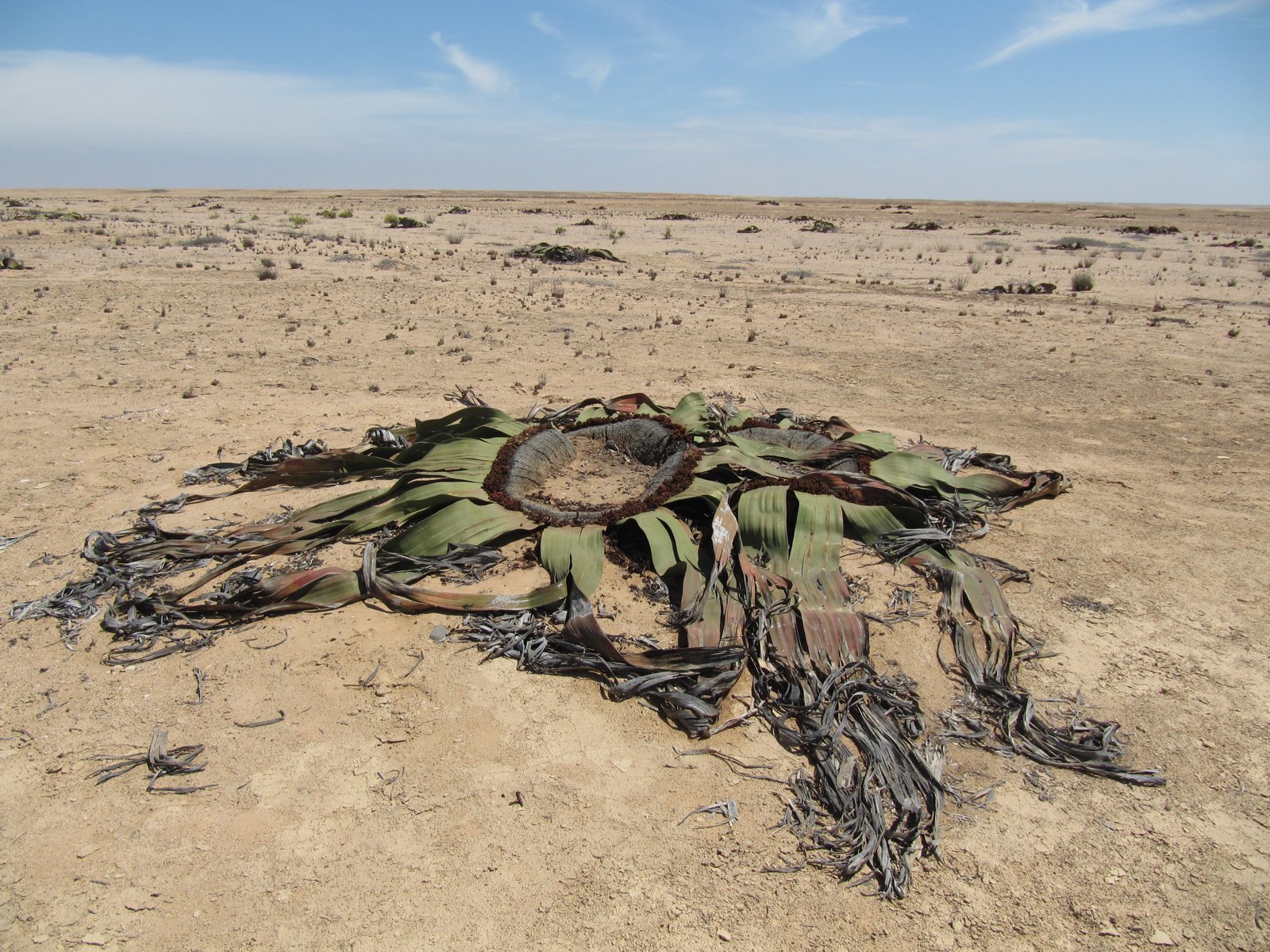
Welwitschia lives in scattered populations along roughly 1,000 kilometres of the Namib Desert in Namibia and southern Angola, generally within the coastal fog belt. Rain is sparse and unreliable. Fog adds moisture to the habitat, while the plant’s long root and its occurrence in dry watercourses point to water below the surface as another important supply. Claims that the leaves simply drink all the water they need from fog overlook that larger system.
A seedling begins with an ordinary growing tip, but that shoot apex dies early. Growth continues from basal meristems beside two permanent leaves, which emerge from grooves at the top of the squat woody stem. Wind, sand, and age tear the older leaf tissue into straps. A large plant can look like a heap of many leaves even though it has kept the same pair.
Male and female cones occur on separate plants. Nectar and the relatively small amount of pollen indicate insect pollination, though the principal wild pollinator has not been settled. Female cones release winged seeds that travel on the wind. Successful establishment depends on unusually sustained rain, and many seeds are lost to fungi or animals before they can become seedlings.
Ages are difficult to measure precisely in a living plant whose stem does not form a simple countable record. Botanical sources commonly estimate lifespans of many centuries; some large individuals are thought to exceed 2,000 years. Those figures are estimates rather than birthdays. The continuous leaves may therefore be among the longest-lived leaf organs known, with young tissue near the base and progressively older tissue toward the damaged tips.
A 2021 chromosome-level study assembled a genome of about 6.8 billion DNA bases. It found evidence of an ancient whole-genome duplication, later bursts of mobile genetic elements, and changes in gene families or expression associated with cell growth and responses to heat, water stress, and limited nutrients. These associations help researchers frame the plant’s biology; they do not identify a single gene that explains its longevity.
Welwitschia is the only living species in its family, and sequence evidence places its gnetophyte lineage close to conifers despite its unfamiliar appearance. It remains locally common and is legally protected in its range. Kew also notes evidence that climate change may alter suitable habitat. Longevity protects an established plant from short dry spells, yet it cannot guarantee that seeds will find the rare conditions needed to replace old individuals.