A CLOSER LOOK
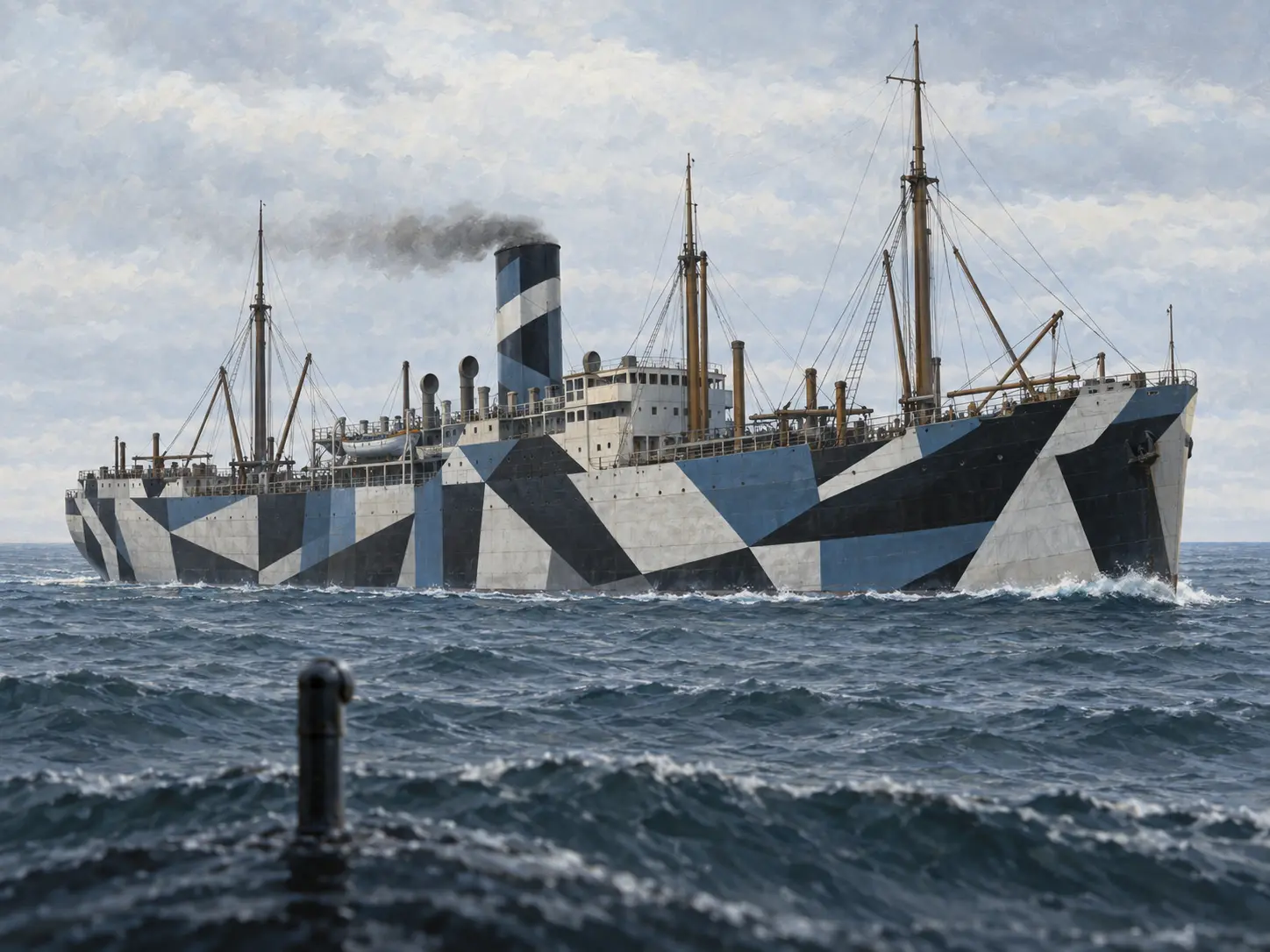
Dazzle camouflage covered ships with large fields of contrasting color and irregular geometry. A submarine observer looking through a periscope had to estimate a target’s heading, speed, and distance before calculating a torpedo course. The patterns were intended to make those visual estimates less dependable by breaking up familiar cues such as the bow, stern, funnels, and apparent bow wave.
British marine artist and Royal Navy Volunteer Reserve officer Norman Wilkinson proposed the system during the U-boat campaign of 1917. His Dazzle Section used painted models to test designs, then prepared different patterns for the port and starboard sides of ships. Imperial War Museums records that the group produced schemes for thousands of British cargo vessels and hundreds of warships. The United States developed its own tested design types through the Navy’s Bureau of Construction and Repair.
The pattern on a ship was part of a targeting contest shaped by viewing angle and motion. Curves could resemble a false bow wave, diagonal forms could alter the apparent direction of funnels, and different treatments on each side answered the ship’s changing presentation to an observer. Brightness contrast mattered more than simply using many colors, according to the U.S. Naval History and Heritage Command.
Its success is difficult to measure from wartime loss totals. Ships differed in route, escort, speed, and exposure, so a painted fleet did not provide a clean comparison with an untreated one. Modern perception experiments have found modest directional biases in some patterns, together with other viewing effects that could reduce or cancel the advantage. Dazzle remains a documented attempt to engineer uncertainty; the evidence does not support treating every dramatic design as proven protection.