A CLOSER LOOK
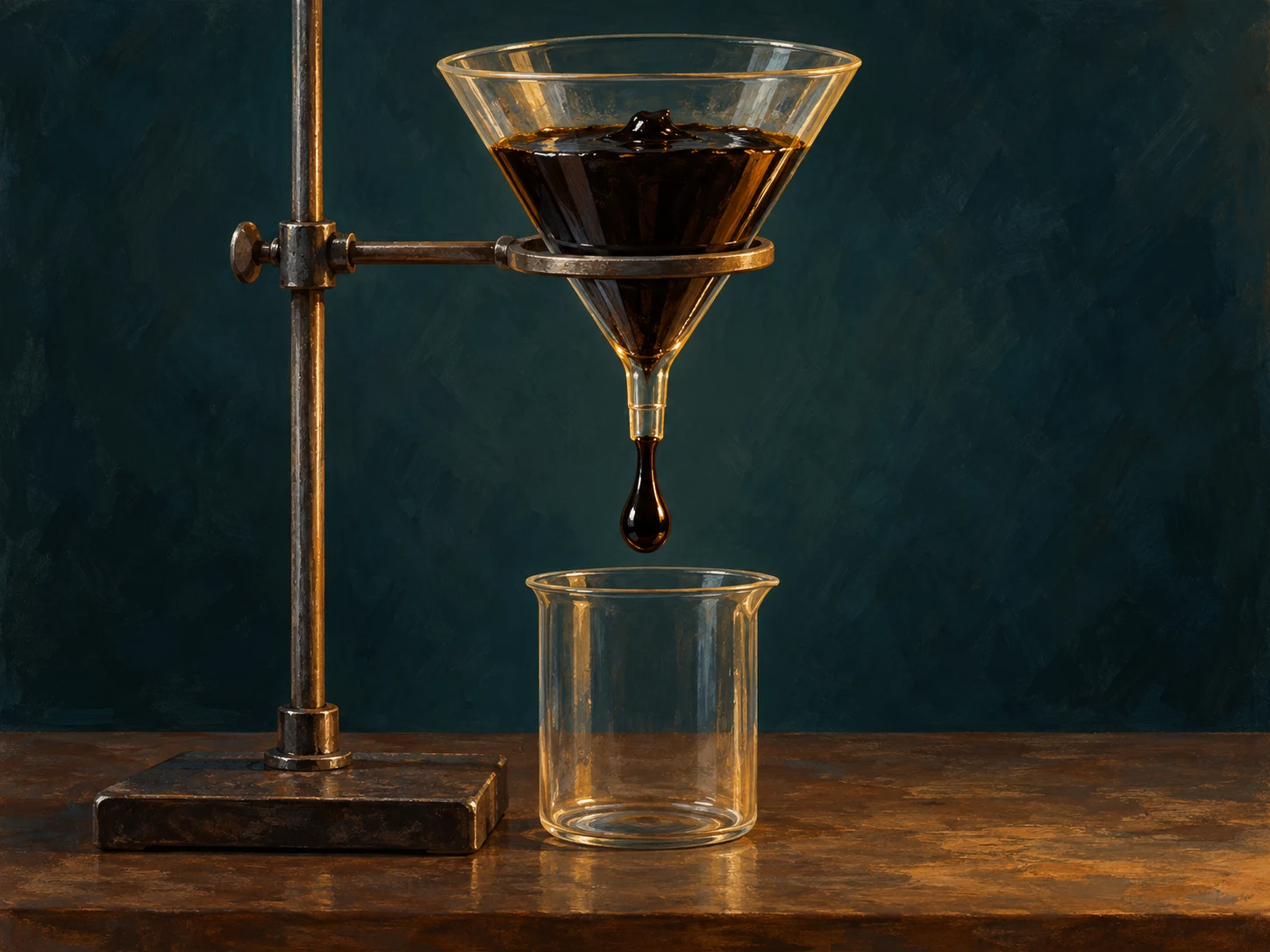
Physics professor Thomas Parnell began the demonstration in 1927. He heated pitch, poured it into a glass funnel with a sealed stem, and left it to settle for three years. In 1930 he cut the stem. The first drop took eight more years to fall.
Pitch is a tar-derived material once used for waterproofing boats. At room temperature it can be hard enough to shatter under a hammer, yet the experiment shows that it continues to flow. University measurements place this sample’s viscosity at roughly 100 billion times that of water.
Nine drops have fallen. The ninth touched the eighth in April 2014, and the accumulated material required a fresh receiving beaker. Long gaps make each event difficult to witness: earlier custodians found a completed drop after the fact, and a power failure prevented a camera from recording the eighth drop in 2000.
The apparatus was built as a lecture demonstration and does not have tightly controlled laboratory conditions. Seasonal temperature changes, air conditioning, display lighting, the shrinking mass in the funnel, and contact between drops have all affected its rate. The irregular timing is part of the record, so estimates for the next drop remain uncertain.