A CLOSER LOOK
Bedford retreats to rural Kent intending to write a play after failed business ventures. He meets Cavor, a scientist so absorbed in his research that his daily walk has become an unconscious routine. Their partnership joins Bedford’s commercial appetite to Cavor’s theoretical invention, giving the expedition divided motives from the beginning.
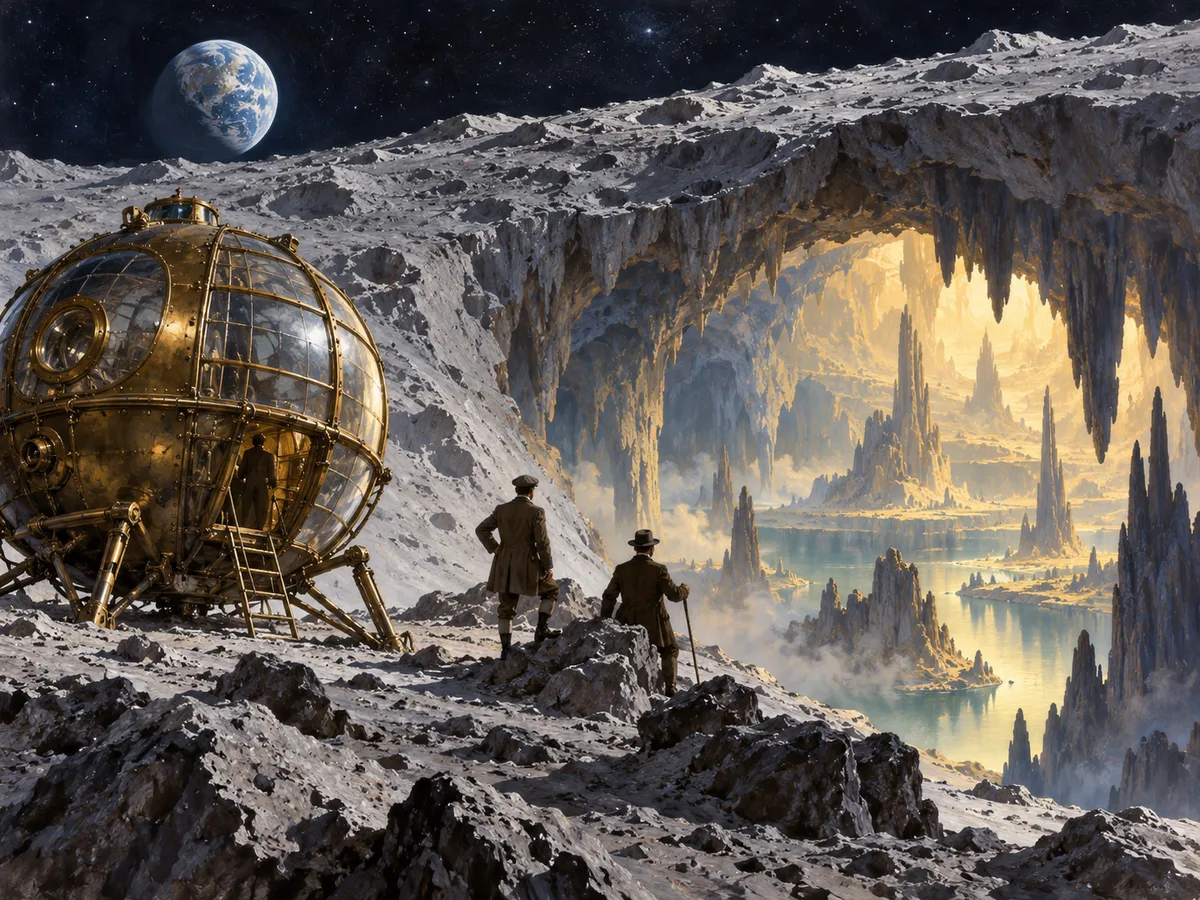
Cavor’s fictional material, Cavorite, blocks gravitational attraction. A first experiment sends the air and loose structures above it upward with destructive force. He then proposes a steel sphere lined with thick glass and fitted with Cavorite shutters. By opening and closing sections, the travelers can change which bodies attract the sphere and steer it through space.
The lunar adventure moves below the surface, where Bedford and Cavor encounter the Selenites. Project Gutenberg catalogs the book under science fiction, satire, utopian fiction, imperialism, and lunar space flight. Those subjects point to the book’s reach beyond prediction: its invented society turns specialization and exploration into questions about power.
Project Gutenberg identifies H. G. Wells as the author, records the work as a public-domain U.S. edition, and provides the complete text in several formats. Cavorite and the Selenites belong to the novel’s fiction, not scientific history. The generated illustration is a new interpretation of the sphere and underground Moon, with no claim to be an original edition plate.