A CLOSER LOOK
The charter addresses an immediate conflict between King John and his barons. Its opening grants freedoms to the English Church and enumerates liberties for free men, then moves through inheritance payments, guardianship, debts, taxation, local courts, trade, and the conduct of royal officials. It is a negotiated program for governing specific relationships in a feudal kingdom.
Clauses 39 and 40 became especially durable: they connect imprisonment and loss of rights to lawful judgment and the law of the land, and promise that justice will not be sold, denied, or delayed. Other provisions are far more concrete, including proportional fines, fixed locations for ordinary lawsuits, standardized measures, and removal of fish-weirs from English rivers.
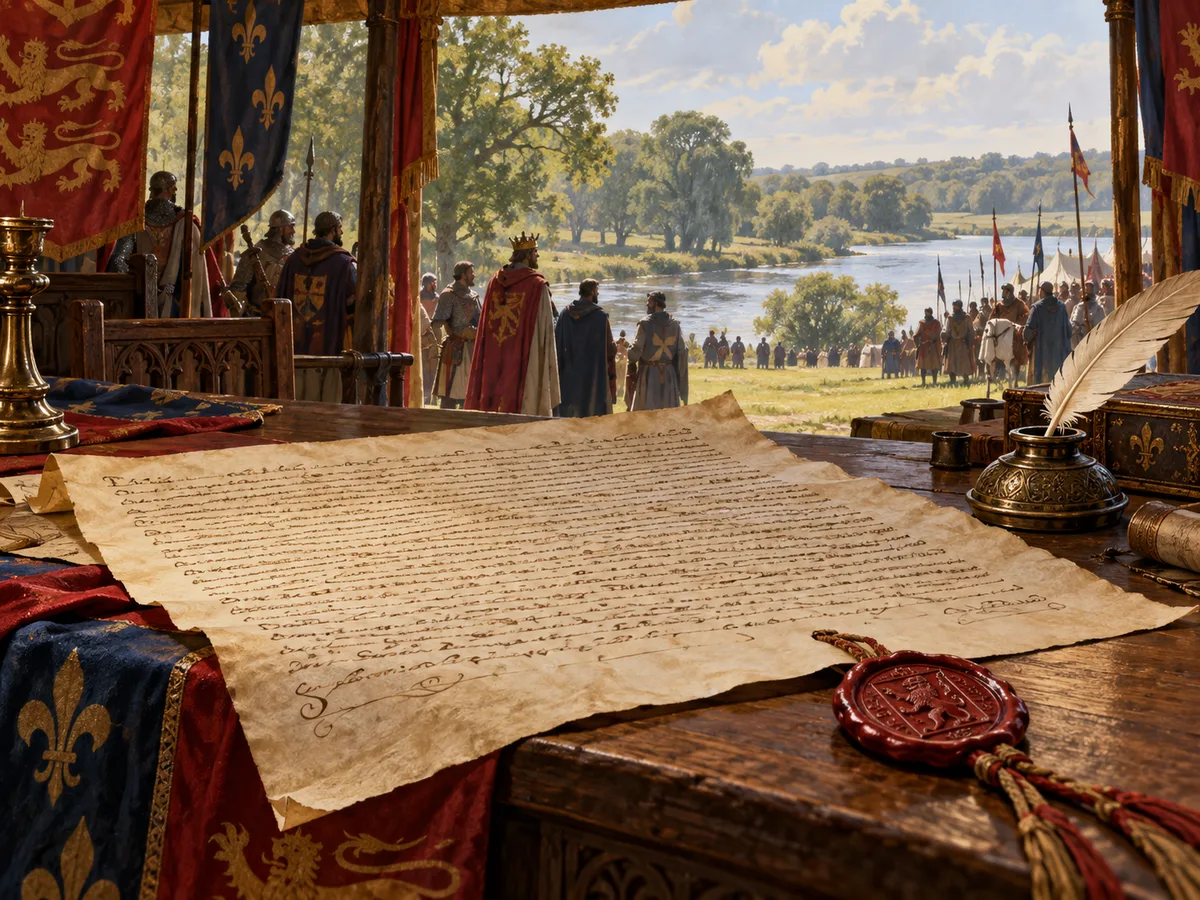
The security clause gives twenty-five barons responsibility for enforcing the settlement and permits pressure against the king’s property if redress is withheld. The text closes at Runnymede on 15 June during the seventeenth year of John’s reign. Those details show a contested political agreement whose later reputation expanded beyond its original audience.
Project Gutenberg marks ebook 10000 public domain in the United States and supplies multiple English versions. Its preparer warns that some versions were damaged in transmission and may contain spacing or character errors, so this edition is useful for discovery rather than authoritative textual or legal citation. The generated illustration is a modern interpretation, not a facsimile or surviving artifact.