YOUR NEXT DISCOVERY/SpaceFollow your curiosity
Morphology of Our Galaxy Twin
NASA / JPL · Reuse terms

Space / 2004-06-28

Morphology of Our Galaxy Twin

Morphology of Our Galaxy Twin

NASA's image library records Morphology of Our Galaxy Twin.

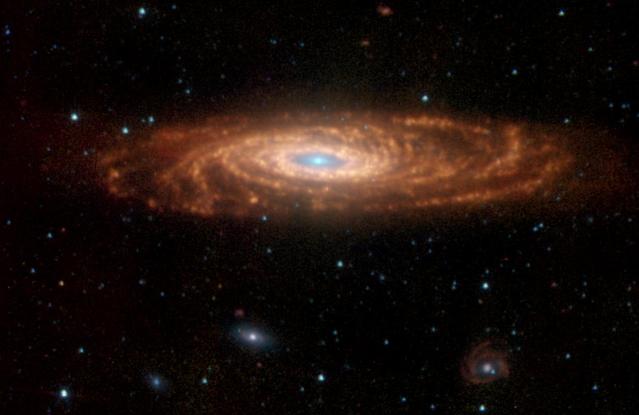
NASA's Spitzer Space Telescope has captured these infrared images of a nearby spiral galaxy that resembles our own Milky Way. The targeted galaxy, known as NGC 7331 and sometimes referred to as our galaxy's twin, is found in the constellation Pegasus at a distance of 50 million light-years. This inclined galaxy was discovered in 1784 by William Her

SERENDIPITYA little unexpected
FamiliarWeird

NASA's Spitzer Space Telescope has captured these infrared images of a nearby spiral galaxy that resembles our own Milky Way. The targeted galaxy, known as NGC 7331 and sometimes referred to as our galaxy's twin, is found in the constellation Pegasus at a distance of 50 million light-years. This inclined galaxy was discovered in 1784 by William Herschel, who also discovered infrared light. The evolution of this galaxy is a story that depends significantly on the amount and distribution of gas and dust, the locations and rates of star formation, and on how the energy from star formation is recycled by the local environment. The new Spitzer images are allowing astronomers to "read" this story by dissecting the galaxy into its separate components. The image, measuring 12.6 by 8.2 arcminutes,

Explore NASA's original image record for credits and available downloads.

NASA Image and Video LibraryMorphology of Our Galaxy Twin

Original explanation based on the sources above. Images carry their own reuse terms.