YOUR NEXT DISCOVERY/SpaceFollow your curiosity
Hubble Sees Stars and a Stripe in Celestial Fireworks
NASA / GSFC · Reuse terms

Space / 2017-12-08

Hubble Sees Stars and a Stripe in Celestial Fireworks

Hubble Sees Stars and a Stripe in Celestial Fireworks

NASA's image library records Hubble Sees Stars and a Stripe in Celestial Fireworks.

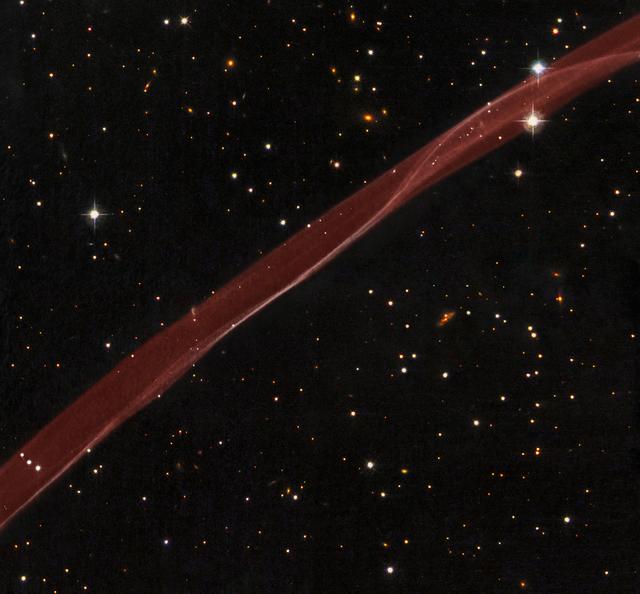
Release date: July 1, 2008 SN 1006 Supernova Remnant (Hubble) A delicate ribbon of gas floats eerily in our galaxy. A contrail from an alien spaceship? A jet from a black-hole? Actually this image, taken by NASA's Hubble Space Telescope, is a very thin section of a supernova remnant caused by a stellar explosion that occurred more than 1,000 years

SERENDIPITYA little unexpected
FamiliarWeird

Release date: July 1, 2008 SN 1006 Supernova Remnant (Hubble) A delicate ribbon of gas floats eerily in our galaxy. A contrail from an alien spaceship? A jet from a black-hole? Actually this image, taken by NASA's Hubble Space Telescope, is a very thin section of a supernova remnant caused by a stellar explosion that occurred more than 1,000 years ago. On or around May 1, 1006 A.D., observers from Africa to Europe to the Far East witnessed and recorded the arrival of light from what is now called SN 1006, a tremendous supernova explosion caused by the final death throes of a white dwarf star nearly 7,000 light-years away. The supernova was probably the brightest star ever seen by humans, and surpassed Venus as the brightest object in the night time sky, only to be surpassed by the moon. It

Explore NASA's original image record for credits and available downloads.

NASA Image and Video LibraryHubble Sees Stars and a Stripe in Celestial Fireworks

Original explanation based on the sources above. Images carry their own reuse terms.