YOUR NEXT DISCOVERY/SpaceFollow your curiosity
30 Million light-years Away Hubble Sees Merging Galaxies
NASA / GSFC · Reuse terms

Space / 2017-12-08

30 Million light-years Away Hubble Sees Merging Galaxies

30 Million light-years Away Hubble Sees Merging Galaxies

NASA's image library records 30 Million light-years Away Hubble Sees Merging Galaxies.

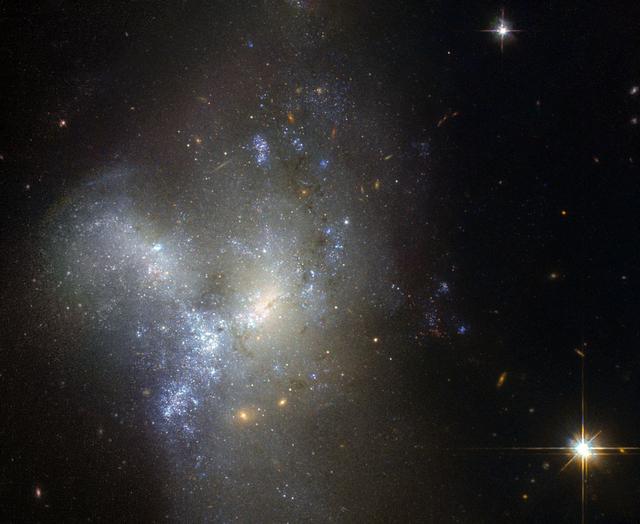
This image, taken by the NASA/ESA Hubble Space Telescope, shows a peculiar galaxy known as NGC 1487, lying about 30 million light-years away in the southern constellation of Eridanus. Rather than viewing it as a celestial object, it is actually better to think of this as an event. Here, we are witnessing two or more galaxies in the act of merging t

SERENDIPITYA little unexpected
FamiliarWeird

This image, taken by the NASA/ESA Hubble Space Telescope, shows a peculiar galaxy known as NGC 1487, lying about 30 million light-years away in the southern constellation of Eridanus. Rather than viewing it as a celestial object, it is actually better to think of this as an event. Here, we are witnessing two or more galaxies in the act of merging together to form a single new galaxy. Each galaxy has lost almost all traces of its original appearance, as stars and gas have been thrown by gravity in an elaborate cosmic whirl. Unless one is very much bigger than the other, galaxies are always disrupted by the violence of the merging process. As a result, it is very difficult to determine precisely what the original galaxies looked like and, indeed, how many of them there were. In this case, it

Explore NASA's original image record for credits and available downloads.

NASA Image and Video Library30 Million light-years Away Hubble Sees Merging Galaxies

Original explanation based on the sources above. Images carry their own reuse terms.