YOUR NEXT DISCOVERY/SpaceFollow your curiosity
Early Rockets
NASA / MSFC · Reuse terms

Space / 1958-01-31

Early Rockets

Early Rockets

NASA's image library records Early Rockets.

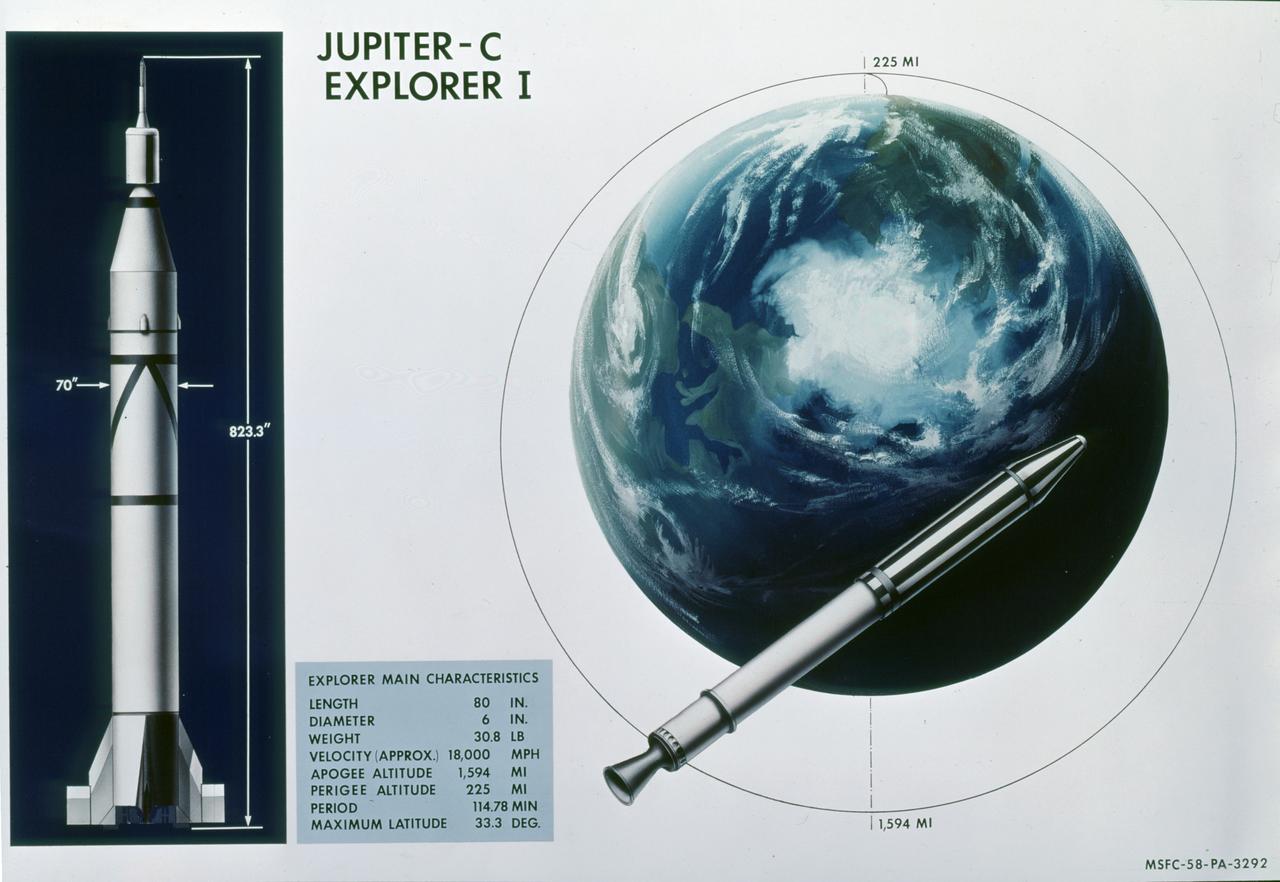
This illustration shows the main characteristics of the Jupiter C launch vehicle and its payload, the Explorer I satellite. The Jupiter C, America's first successful space vehicle, launched the free world's first scientific satellite, Explorer 1, on January 31, 1958. The four-stage Jupiter C measured almost 69 feet in length. The first stage was a

SERENDIPITYA little unexpected
FamiliarWeird

This illustration shows the main characteristics of the Jupiter C launch vehicle and its payload, the Explorer I satellite. The Jupiter C, America's first successful space vehicle, launched the free world's first scientific satellite, Explorer 1, on January 31, 1958. The four-stage Jupiter C measured almost 69 feet in length. The first stage was a modified liquid fueled Redstone missile. This main stage was about 57 feet in length and 70 inches in diameter. Fifteen scaled down SERGENT solid propellant motors were used in the upper stages. A "tub" configuration mounted on top of the modified Redstone held the second and third stages. The second stage consisted of 11 rockets placed in a ring formation within the tub. Inserted into the ring of second stage rockets was a cluster of 3 rockets m

Explore NASA's original image record for credits and available downloads.

NASA Image and Video LibraryEarly Rockets

Original explanation based on the sources above. Images carry their own reuse terms.