A CLOSER LOOK
Project Gutenberg’s text follows the posthumous 1798 edition and identifies the work as a fragment. William Godwin’s editorial preface says Wollstonecraft had revised the manuscript repeatedly and did not regard it as finished. The edition joins fourteen developed chapters to later material, an appendix, and several brief outlines for a conclusion. Those layers preserve uncertainty about the final sequence instead of supplying one settled ending.
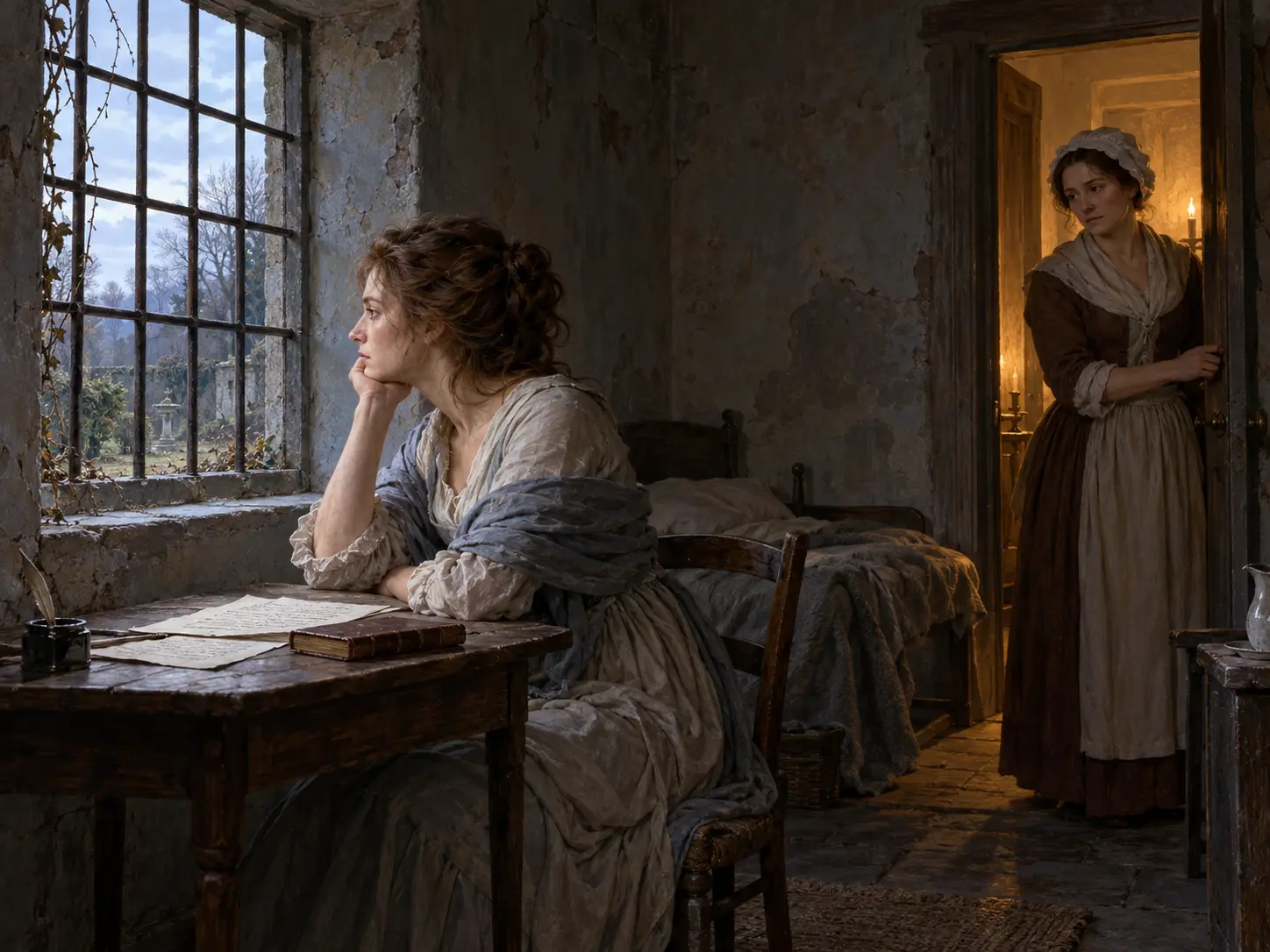
The opening borrows the atmosphere of Gothic imprisonment and locates its horror in an ordinary exercise of social power. Maria’s husband has confined her on a false claim of madness and separated her from her infant daughter. Her barred room matters as a physical setting, while the sharper danger is that other people can translate her anger, grief, and intelligence into evidence against her.
Jemima begins as Maria’s keeper. Their relationship changes as she listens, obtains books and writing materials, and describes her own history of abandonment, exploited labor, sexual coercion, and poverty. The novel places the women’s accounts beside one another without making their circumstances identical. Sympathy becomes a way of recognizing a shared system whose injuries take different forms according to wealth and social position.
Maria writes a memoir for her daughter, turning confinement into an attempt to preserve knowledge that might help another woman. Wollstonecraft’s authorial preface names the project directly: she intended to portray oppression produced by partial laws and customs and to treat the history as belonging to “woman” rather than one exceptional individual. The generated illustration interprets the opening room and Maria’s developing alliance with Jemima; it is not an image from the 1798 edition.