A CLOSER LOOK
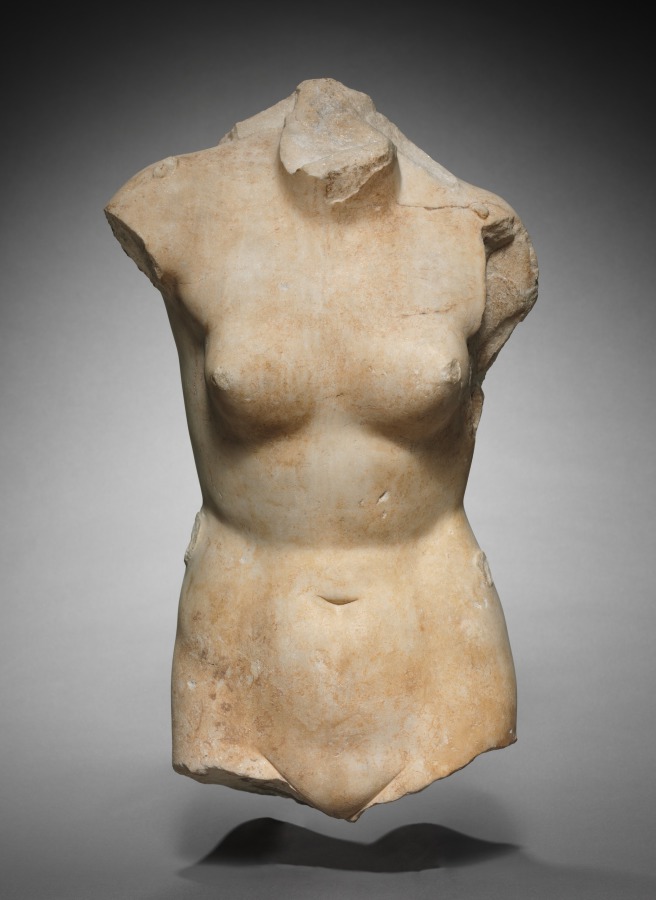
The museum identifies this sculpture as Thasian marble.
The museum's collection notes: This torso can be identified through its nudity and pose as the Greek goddess of love, Aphrodite. Based on the now-lost Aphrodite of Knidos, a revolutionary marble sculpture created by Praxiteles of Athens in the mid-300s BCE, this sculpture belongs to a popular Greek and Roman type showing the goddess at her bath. With hips slightly shifted, she stood in a relaxed posture with most of her weight on one leg, probably with one hand modestly covering her pubic region and the other shielding her breasts or holding drapery. Alternatively, one or both hands may have tended to her wet hair, some of which falls over her neck and upper back.