YOUR NEXT DISCOVERY/ArtifactsFollow your curiosity
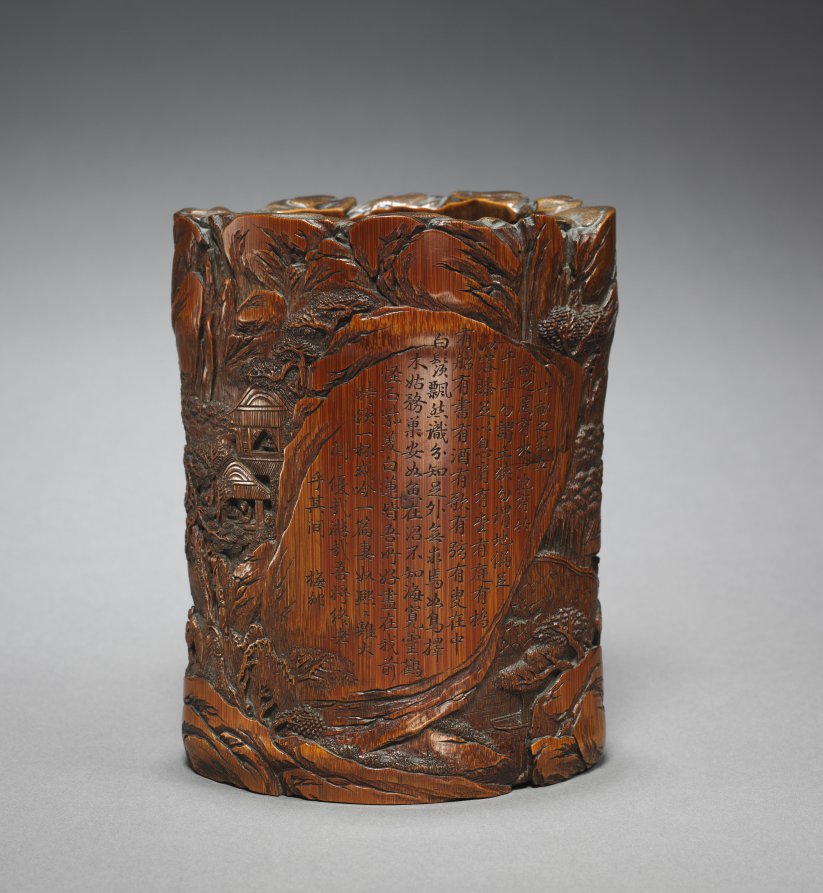
Brush Holder with Figures in Landscape and Poetic Inscription by Wang Meilin from Jiading, from The Cleveland Museum of Art
The Cleveland Museum of Art · Open Access · Reuse terms

China, Qing dynasty (1644-1911), Daoguang reign (1821-50) / 1800s

Brush Holder with Figures in Landscape and Poetic Inscription by Wang Meilin from Jiading

Brush Holder with Figures in Landscape and Poetic Inscription by Wang Meilin from Jiading

The Cleveland Museum of Art catalogs Brush Holder with Figures in Landscape and Poetic Inscription by Wang Meilin from Jiading as wood (China, Qing dynasty (1644-1911), Daoguang reign (1821-50) · 1800s).

Bamboo was considered a humble material that suited the Confucian ideals of frugality and modesty.

SERENDIPITYA little unexpected
FamiliarWeird

The museum identifies this wood as carved bamboo and credits Wang Meilin (Chinese, active c. 1825).

The museum's collection notes: This bamboo brush holder shows a scholar inside a mountain retreat under trees. On its back side, a cliff inscribed with a text by the Tang poet Bai Juyi (772–846) describes the carefree life of a scholar among family and servants in the countryside. The text in cursive script style calligraphy ( xingshu ) says: A ten-acre [home], a five-acre yard with a water pool, and a thousand bamboos. Don’t say the field is narrow, or the location remote. It is enough to accommodate the knee and rest the shoulder. It has a hall and a yard, a bridge and a boat. It has books and wine, songs and string [instruments]. An old man in the midst of it, his white

The Cleveland Museum of ArtBrush Holder with Figures in Landscape and Poetic Inscription by Wang Meilin from Jiading

Original explanation based on the sources above. Images carry their own reuse terms.