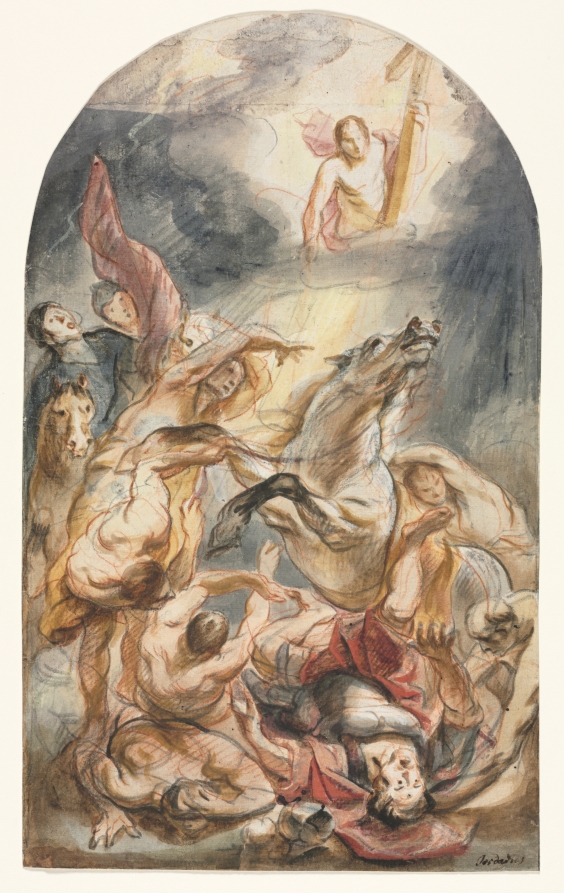
A CLOSER LOOK
The museum identifies this drawing as brush and brown wash, gouache and watercolor over black and red chalk, heightened with traces of white; framing lines in graphite and credits Jacob Jordaens (Flemish, 1593–1678).
The museum's collection notes: Jacob Jordaens was a prominent artist working in Antwerp in the 17th century. Though influenced in his use of powerful forms and vibrant color by his contemporary, Peter Paul Rubens, Jordaens was notably more realist in his tendencies. This drawing and its companion drawing in the Cleveland Museum of Art's collection (1954.366) are very likely studies for a painting depicting the Conversion of Saint Paul that Jordaens made for the the abbey church at Tongerlo, near Antwerp, in around 1647 (now lost). According to the Bible, in the year following the death of Jesus Christ, Saul of Tarsus (who became Saint Paul) was on the road to Damascus. He