YOUR NEXT DISCOVERY/ArtifactsFollow your curiosity
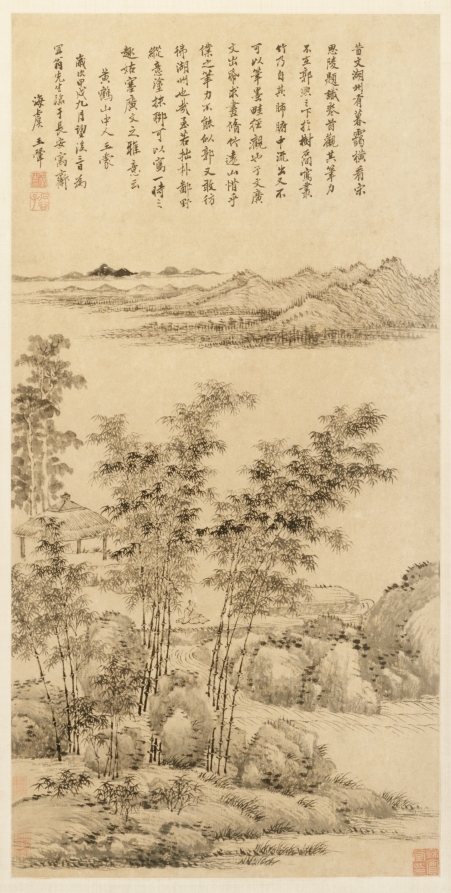
Tall Bamboo and Distant Mountains, after Wang Meng, from The Cleveland Museum of Art
The Cleveland Museum of Art · Open Access · Reuse terms

China, Qing dynasty (1644–1911) / 1694

Tall Bamboo and Distant Mountains, after Wang Meng

Tall Bamboo and Distant Mountains, after Wang Meng

The Cleveland Museum of Art catalogs Tall Bamboo and Distant Mountains, after Wang Meng as painting (China, Qing dynasty (1644–1911) · 1694).

As a leading figure in the Orthodox School of Chinese painting, Wang Hui believed that the act of painting was a dialogue with one or more masters of the past.

SERENDIPITYA little unexpected
FamiliarWeird

The museum identifies this painting as Hanging scroll; ink on paper and credits Wang Hui (Chinese, 1632–1717).

The museum's collection notes: Wang Hui studied paintings by earlier masters and digested their styles with unceasing virtuosity. He had such enduring affection for a landscape by Wang Meng 王蒙 (about 1308–85) that between 1686 and 1712, he made several copies, like this example. One of his compositional transformations here was moving the scholar from the pavilion directly into the landscape by the stream. His faithful copying also included inscriptions. Wang Meng had written that he was trying to resuscitate the style of an earlier artist, Wen Tong (1018–1079); therefore, Wang Hui sought to revive both Wang Meng and Wen Tong.

The Cleveland Museum of ArtTall Bamboo and Distant Mountains, after Wang Meng

Original explanation based on the sources above. Images carry their own reuse terms.