A CLOSER LOOK
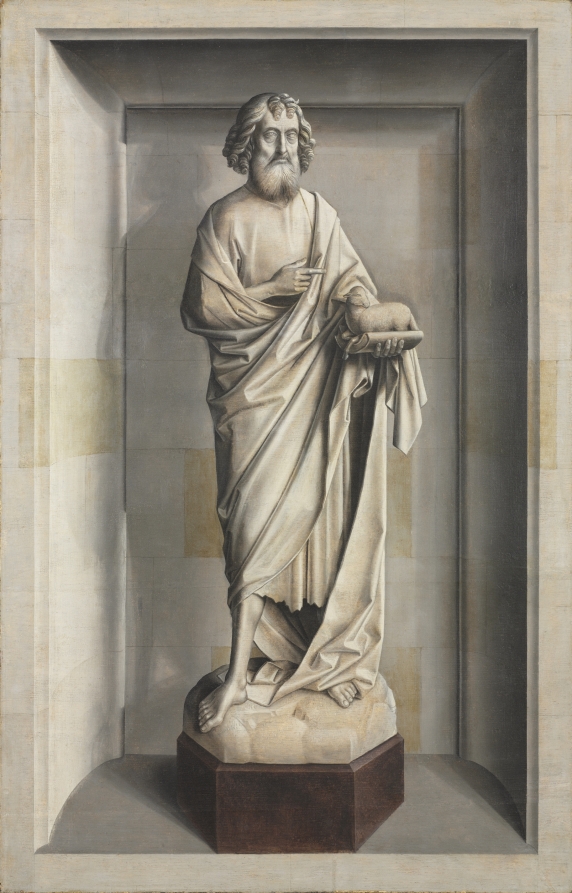
The museum identifies this painting as oil on wood (grisaille) and credits Dieric Bouts (Netherlandish, 1415–1475).
The museum's collection notes: This panel once formed part of an altarpiece painted for the Church of Saint Laurentius in Cologne. It originally comprised the reverse of the arrest of Christ, now in the Alte Pinakothek in Munich. Another grisaille panel representing Saint John the Evangelist, also in Munich, formed the exterior of the resurrection. The grisaille technique was a monochromatic method utilizing various shades of gray, often in imitation of sculpture, as is the case here. The illusionistic effect suggests a sculpture not set back in a niche, but clearly separated from it to enhance the three-dimensional appearance. Dieric Bouts was born in Haarlem in Holland,