YOUR NEXT DISCOVERY/ArtifactsFollow your curiosity
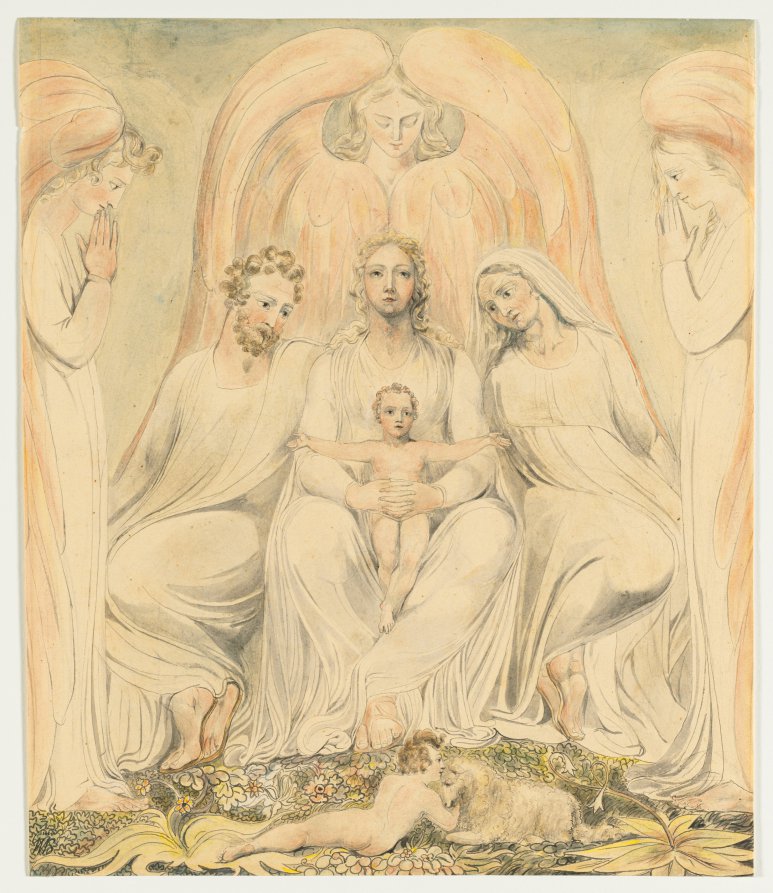
The Holy Family (Christ in the Lap of Truth), from The Cleveland Museum of Art
The Cleveland Museum of Art · Open Access · Reuse terms

England, London / c. 1805

The Holy Family (Christ in the Lap of Truth)

The Holy Family (Christ in the Lap of Truth)

The Cleveland Museum of Art catalogs The Holy Family (Christ in the Lap of Truth) as drawing (England, London · c. 1805).

This drawing was first owned by Thomas Butts, an English civil servant who became William Blake's most important patron and supporter for about two decades.

SERENDIPITYA little unexpected
FamiliarWeird

The museum identifies this drawing as black, gray, and brown ink applied with pen and point of brush; gray, pink, yellow, and green wash and credits William Blake (British, 1757–1827).

The museum's collection notes: Although he rejected institutionalized religion, Blake was intensely spiritual, and much of his art was inspired by a highly personal reading of the Bible or by literature based upon it, such as John Milton’s Paradise Lost (1667). The Virgin Mary is centered in this highly stylized composition. Upon her lap she clasps the infant Christ whose outstretched arms foreshadow the Crucifixion. The Mother and Child are flanked by Saint Joseph on the left, and Saint Anne (the Virgin’s mother), on the right. Below, Saint John the Baptist, who foretold Christ’s death and resurrection, plays with a lamb.

The Cleveland Museum of ArtThe Holy Family (Christ in the Lap of Truth)

Original explanation based on the sources above. Images carry their own reuse terms.