A CLOSER LOOK
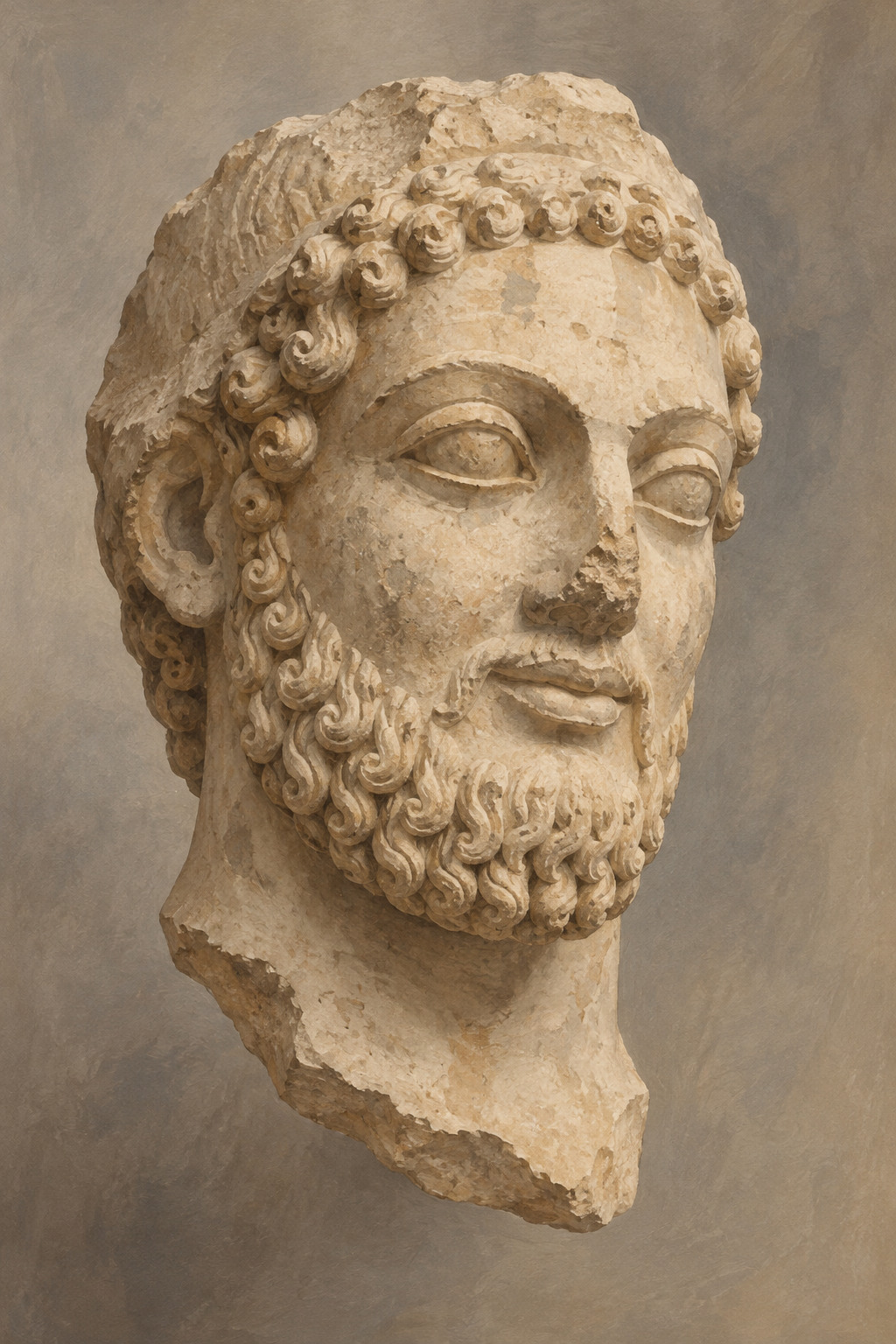
The Art Institute identifies this limestone head as Cypriot and dates it to the fifth century BCE. Almond-shaped eyes, face-framing ringlets, and a faint smile recall conventions familiar from Greek Archaic sculpture of the preceding century. Those features give the fragment its historical tension: its date belongs to a period of changing Greek styles, while its face preserves an older visual vocabulary.
Cyprus sat among artistic networks linking the Aegean and the Levant. The museum notes that the sculptor may have visited Greece or otherwise known earlier Greek art. That proposal explains the resemblance without turning it into a documented journey. A surviving head can demonstrate formal knowledge; by itself it cannot identify the route by which that knowledge arrived or the reason an older manner was chosen.
Other Cypriot heads show that no single outside model accounts for the island’s sculpture. An early sixth-century BCE limestone head at the Metropolitan Museum combines a conical cap with rounded beard curls that the museum relates to terracotta practice. A Met head from the early fifth century wears a wreath and has a more serious expression associated with contemporary Greek art. Read beside them, the Chicago fragment belongs to a varied local field in which sculptors selected and reworked forms rather than following one synchronized sequence.
Only the head survives here, so the figure’s identity, pose, scale, purpose, and original setting remain uncertain. Period labels such as “Archaic” and “Classical” are interpretive tools, especially when applied across regions. The generated illustration emphasizes the described eyes, ringlets, beard, smile, and worn limestone surface. It is not a photograph of the Art Institute object, an exact reconstruction, or evidence for missing details.